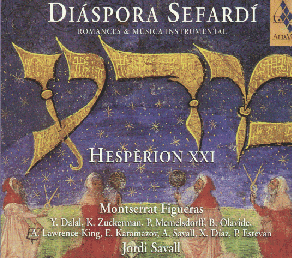
Artistes / Performers
Hespèrion XXI, direction: Jordi
Savall
Montserat Figueras, soprano, Yair
Dalal, oud,
Ken Zuckerman, Pedro Memelsdorff, Begoña Olavide, Andrew
Lawrence-King, Edin Karamazov, Arianna Savall, Xavier Diaz, Pedro
Estevan Lieu d'enregistrement / Recording site: Collégiale du Château de Cardona,
Catalogne (Espagne/Spain)
Date d'enregistrement:
Printemps de 1999
Recording date: Spring of 1999
"Savant
mélange que les romances et musiques sépharades présentées par
Jordi Savall sur ces deux CD défiant toute classification :
musique savante, populaire, traditionnelle ? Savante pour
certaines, de par leur ancienneté, de par le fait qu'elles
faisaient déjà partie de recueils - donc, musique écrite ;
populaire, par le caractère d'improvisation pure de certains
morceaux - mais de Bach à Duruflé, qui n'a improvisé ? ;
traditionnelle, par une certaine utilisation de l'instrumentarium
classique nord-africain ou médiéval espagnol. Quoi qu'il en soit,
il en résulte une suite de musiques de grand charme,
extraordinairement diverses : rien d'étonnant, si l'on considère
les innombrables influences auxquelles ont été soumises les Juifs
expulsés de terre en terre. Et si la langue dans laquelle chante
Montserrat Figueras est bien l'espagnol (certes archaïque, teinté
de catalan, grec, arabe ou turc), la musique puise ses sources
dans les cultures bulgare, roumaine, serbocroate, bosniaque,
italienne, grecque, turque, arabe d'Afrique du Nord, et
naturellement espagnole."
"En 1492, les juifs furent expulsés
d’Espagne par un décret royal des couronnes de Castille et
d’Aragon. Les expulses émigrèrent - non sans parfois de pénibles
péripéties- vers l’Afrique du Nord, vers le puissant et ample
Empire Ottoman, ou vers certains pays d’Europe, tels le sud de la
France, l’Italie ou le Portugal si proche. Mais le refuge
portugais fut de courte durée: cinq ans plus tard seulement, en
1497, les juifs du Portugal se virent obligés, par ordre royal. ou
à se convertir ou à abandonner le royaume. L’inexistence à
l’époque de l’Inquisition au Portugal —elle ne devait s’implanter
qu’un demi-siècle plus tard— rendit possible le fait qu’une partie
des convertis de force continuent à pratiquer leur ancienne
religion en cachette et forment des groupes crypto-judaiques qui,
durant les XVIème et XVIIème siècles formèrent la base de
nouvelles communautés israélites aux Pays Bas ou en Italie.
Certains de ces convertis, de retour au judaïsme vinrent
s’intégrer aux communautés séfarades d’Afrique du Nord ou de
l’Orient méditerranéen."
"C’est ainsi que s’est formé, grosso modo, le monde séfarade. Il
est bien connu qu’une partie importante des juifs originaires de
la Péninsule ibérique, installés dans des pays riverains de la
Méditerranée, ont gardé jusqu’au XXème siècle l’usage de
l’espagnol comme langue de communication et comme langue
littéraire: et qu’avec la langue, ils ont gardé les us et
coutumes, les influences littéraires et les traits culturels en
tous genre de cette origine hispanique."
...
"Tout cet amalgame d’influences apparaît dan l’anthologie Diaspora
Sefardi dans laquelle Hespèrion XXI recrée un éventail
représentatif de chansons et romances des séfarades
d’Orient. Dans le domaine musical, nous trouvons ici, unies à de
probables héritages de la musique médiévale hispanique, les
influences évidentes de la musique culte qui s’est développée dès
le XVlème siècle au sein de 1’Empire Ottoman (et que les séfarades
adoptèrent promptement, y compris dans leurs chants liturgiques)
et aussi de la musique populaire des peuples des balkans."
Paloma Díaz-Mas
Traduction: Irène Bloc
"In 1492 the Jews were
expelled by royal edict from the Crowns of Castile and Aragon.
Following their expulsion, the Jews emigrated —often after great
hardship— to north Africa, to the lands of the then vast and
powerful Ottoman empire, or to some European country such as the
southern France, Italy or nearby Portugal. Their refuge in
Portugal was short lived, however: only five years later, in 1497,
the Jews of Portugal were also forced, again by royal decree,
either to convert to Christianity or to abandon the kingdom. The
fact that, at that time, there was no Inquisition, in Portugal (it
was not established there until half a century later), enabled
some of those who had been forced to convert to continue secretly
practising their religion. Thus, they formed groups of crypto-Jews
who, throughout the 16th and 17th centuries, were to lay the
foundations of the new Jewish communities in the Low Countries and
Italy. Some of the converts reverted to Judaism and joined the
communities of Sephardic Jews in north Africa or the eastern
Mediterranean."
"This, in very broad
terms, is how the Sephardic world came into being. It is
well known that. right up until the 20th century, a large
number of those Jews who originated from the Iberian
peninsula and settled in countries around the Mediterranean
have retained Spanish as a language for both everyday
communication and literature, and that, together with the
language, they have preserved customs and practices,
literary influences and all kinds of cultural features of
Hispanic origin."
...
"The mixture of all
these influences isreflected in the anthology “Diaspora
Sefardi”, in which Hespèrion XXI has recreated a
representative sample of songs and ballads of the eastern
Sephardic communities. On a musical level, this selection
shows, together with what are presumably the surviving
traces of medieval Hispanic music, the clear influence of
sophisticated musical forms which developed in the Ottoman
empire from the 16th century (and which were rapidly adopted
by Sephardic Jews, even for use in their liturgical chants),
a well a of the popular music of the Balkans."
Analyste: Tess Knighton
Condensé (traduction libre): Cet article des plus élogieux
porte le titre ronflant de :" Exploration fascinante des
diverses musiques séfarades, reconstituées de façon imaginative
par l'ensemble expert Hespèrion XXI"
Dans sa reconstitution de ce vaste répertoire, l'ensemble
Hespèrion XXI puise tantôt aux sources de l'Espagne médiévale,
mais s'inspire aussi des ballades traditionnelles toujours
vivantes en Grèce ainsi que d'éléments d'origine balkano-turque...
..." le résultat est splendide, exotique, fantastique et à
l'occasion extrêmement émouvant. La voix bien particulière de
Montserrat Figueras semble convenir admirablement bien à ces
mélodies...
"Le jeu des interprètes,
s'inspirant à la fois des traditions orientales et occidentales,
est superbe et le tout nous fournit une expérience d'écoute
saisissante"
"Hautement recommandé."
"Hesperion XXI's recreation of this
repertory casts its net wide, drawing on material from late
medieval Spain, but also adapting living ballad traditions in
Greece and incorporating Balkan-Turkish elements.
...."the result is beautiful, exotic, fantastical and at
times profoundly moving. Montserrat Figueras's distinctive voice
seems ideally suited to the long-breathed, meandering melodies,
punctuated by those sinuous, fluttering, Eastern-sounding
ornaments at which she excels."
"The instrumental accompaniment of plucked and bowed strings,
recorders and percussion, comes across as genuinely improvisatory..."
"The playing of the instrumentalists, drawn from both Western
and Eastern traditions, is superb, and it all makes for compelling
listening."
"Highly recommended."
"Ce double album arpente le vaste répertoire de la
diaspora séfarade, essaimé à travers tout le bassin
méditerranéen, suite à l'édit d'expulsion des Rois Catholiques
en 1492."
Sur le premier disque, "c'est
à Montserrat Figueras, figure emblématique de l'ensemble, qu'est
confié le réveil vocal de l'entreprise: huit Romances où
son instinct .... s'avère, ... incontournable, à l'affût des
différentes mouvances que l'éclatement géographique de la
diaspora implique. .. sa voix fragile demeure irremplaçable,
décryptant le sens intime des mots et avivant au plus juste la
touche amoureuse ou douloureuse, en écho à l'humeur du
texte..."
Le second disque est "...
consacré à des restitutions de pièces seulement
instrumentales".
"... le charme sonore opère encore, Savall ayant
comme nul autre l'art de joindre le style à la séduction et à
la manière....
"Désormais le choix du discophile est clair: cette approche
exhaustive du fonds séfarade s'impose comme une vraie
référence..."
"This
double CD set explores the vast repertoire of the Sephardic Diaspora
which spread across the entire Mediterranean basin after the edict
of expulsion
of the Catholic Kings in 1492." On the first CD, « Montserrat Figueras, figurehead of the ensemble,
is responsible for the vocal part of the enterprise : eight
Romanceswhereher instinctreveals the
extreme diversity of influences as a result from the geographical
explosion of the Diaspora…
Her fragile voice remains unique, deciphering the intimate meaning
of the words and making extremely perceptible the amorous or painful
tones, in full echo to the spirit of the text…”
The second CD is “… made of instrumental pieces only.”
“ but once again, the
musical charm operates. Savall knows as no one else how to link
style to seduction….
»From now on, the music lover will have no other choice: this
exhaustive investigation of the Sephardic repertoire should become
the ultimate reference”.
Nouveau disque de Savall, plus
surprenant que jamais ! Loin du faste et de la luxuriance de la cour
du Roi Soleil, le voici, aux côtés de Montserrat Figueras, dans des
romances des Séfarades d'Orient. À la rencontre de diverses
cultures, cette musique séfarade médiévale s'épanouit dans un
mélange d'influences très diverses. Les motifs hispaniques, arabes,
grecs, turcs,, ou plus généralement balkaniques, s'entrecroisent et
se dessinent sur un horizon pourtant typiquement juif. L'ensemble fait
penser à l'une de ces mosaïques que l'on trouverait dans l'Alhambra
de la Grenade médiévale, où fusionnaient trois grandes
civilisations... Enrichie de tels contacts, cette musique accompagnait
tous les instants de la vie: moments liturgiques, récits
d'événements guerriers (El Moro de Antequera) ou berceuses.
Et tandis que la viole de Jordi Savall enflamme l'atmosphère, une
voix aux couleurs lointaines s'élève, en chants d'amour et en
lamentations... Montserrat Figueras excelle dans ce répertoire très
théâtral, rendant le dynamisme des refrains d'une voix presque
parlée, ou bien adoucissant les passages plus mélancoliques par de
fluides inflexions de la courbe mélodique. Une pointe d'exotisme qui,
relevée d'un corps instrumental en parfaite osmose, recompose
le paysage des bords méditerranéens. Une perfection dans son genre,
et un beau moment de musique, même s'il faut sans doute écouter ce
disque à plusieurs reprises pour espérer en entendre la profondeur.
Goldberg
# 10
(Printemps/Spring 2000)
Appréciation
Evaluation
Goldberg a cessé de publier
avec le # 54
~~~~~~
Goldberg is no longer available.
# 54 was the last issue.
Analyste: Juan
Carlos Asensio
Texte intégral:
"Les aventures du peuple juif qui, en provenance
d'Espagne, a du se disséminer à travers diverses régions d'Europe et
du nord de l'Afrique, ont été exprimées sous la forme de romances
littéraires que l'on a pu entendre à l'époque même de
l'expulsion (1492) : El moro de Antequera ou le Romance
del Conde Olmos alternent dans ce premier CD de l'enregistrement
avec d'autres provenant du reste de l'Europe comme El rey de
Francia ou Por qué llorax blanca Niña, originaires de
Smyrne et de Sarajevo, respectivement. Sa thématique amoureuse et
mélancolique est parfaitement reflétée dans le timbre particulier et
la manière de chanter de Montserrat Figueras, accompagnée par
d'excellents musiciens, tous spécialistes remarquables de leurs
instruments, même si certains sont plus habitués à d'autres
répertoires. Ces musiques et ces textes, transmis de manière orale,
demandent une bonne dose d'imagination pour être portés sur disque -
ce qui ne manque pas à Jordi Savall - afin de pouvoir remplir les
parties vocales de préludes, interludes et postludes, qui
enrichissent le résultat final".
" Le second CD de l'album est dédié à des versions instrumentales de
romances, à l'origine seulement vocales. Normalement la
partie vocale est confiée à l'un des instruments. On remarque
particulièrement l'extrême douceur et le phrasé excellent du
flûtiste Pedro Memelsdorff, souvent suivi du luthiste Yair Dalad,
qui se complètent parfaitement, tout comme les interventions
progressives du tutti, et même la discrète percussion. On peut
souligner les versions expressives avec flûte et percussion seules
de A la una yo nací ou Yo era niña de casa alta, ainsi
que les improvisations sur des thèmes vocaux (Axerico) ou
simplement libres, dans lesquelles le travail du percussionniste
Pedro Estevan est fondamental".
"The adventures and
trials of the Jewish population expelled from Spain and forced to
migrate to various points in Europe and North Africa were set to
music in the form of romances or ballads which could be heard
even at the time of the expulsion (1492). On the first CD of this
album, Spanish pieces such as El moro de Antequera and the
Romance del Conde Olmos alternate with songs from other parts of
Europe, such as El rey de Francia andPor qué llorax
blanca Niña, from Esmirna and Sarajevo, respectively. Montserrat
Figueras reflects perfectly in her style of singing and timbre of
her voice the pieces' erotic and melancholic themes. She is
accompanied by excellent musicians, all notable instrumental
specialists, although some of them are more accustomed to other
repertories. The task of recording the songs and texts, which belong
to an oral tradition, call for a good dose of imagination -
something which Savall does not lack - in order (to) fill out the
vocal parts with preludes, interludes and postludes which enrich the
final result".
"The second CD in the album consists in
instrumental versions of songs which were originally oral ballads.
In most cases, the vocal part is assigned to one of the instruments.
The tenderness and phrasing in the performances of flautist Pedro
Memelsdorff, who is often followed closely by lute player Yair Dalad,
highlight the CD. The two complement each other perfecttly, as well
as the progressional tuttis and the discreet use of percussion. The
expressive pieces for flute and percussion such as A la una yo nací
and Yo era niña de casa alta stand out particularly, as
well as the improvisations on vocal themes (Axerico) and the
free improvisations, to which the work of percussionist Pedro
Estevan is fundamental".
"The
re-creation of the Sephardic lyric tradition seems often to belong
to musicians who have some contact with the early-music community
(an example being the Boston ensemble Voice of the Turtle, with a
number of discs for Titanic in the later 80s and 90s). It seems as
if it ought to belong to members of the Sephardic community as a
living music, rather than a re-creation of a lost tradition — world
music, as we think of it now, rather than something more akin to the
revivification of the songs of the troubadours, with the
contributions of philologists and historians. There is a sense in
which this is "early music," since the Sephardim have often (though
not always) preserved the language spoken in Iberia before 1492. But
half a millennium is a long time, and much if not most of the
musical language comes from elsewhere in the Mediterranean world.
How many of us
know this music from its true sources (in the way that a folkie who
traveled to the Appalachian mountains rather than to Greenwich
Village might)? Not I. And so I can only say that I enjoy the
poetry, the stories in particular, and that Savall and company
provide a musical tapestry that se non è vero, è ben trovato.
My attention did not flag as Figueras spun out her narratives. I
found it less easy to be drawn into the instrumental music on the
second disc, which does not have quite enough sinew to stand on its
own, a case of the parts not adding up to a greater sum.
The sound is
first-rate, and the design of the booklet
is lovely to see. Recommended."
MONDE DE LA MUSIQUE
# 241 03/2000
Analyste: Marc Desmet Des extraits... » Expulsés en 1492, les juifs de la
Péninsule ibérique ont émigré en grande partie vers les rivages
africains et européens de l’Empire ottoman. Le répertoire de poésie
et de chants qui naquit de cet exil irradie une indicible nostalgie,
…
« … le répertoire se
prête à de multiples métamorphoses selon qu’on lui associe plutôt
les inflexions d’un folklore teinté d’oralité ou la parure d’une
musique savante, cultivée dans les grands centres urbains. »
En deux disques ayant chacun leur centre
de gravité (vocal puis instrumental), l’alchimie de timbres est
envoûtante, usant des timbres instrumentaux comme d’autant d’épices
rares. L’équipe réunit aux côtés de Savall des vedettes du
répertoire médiéval (Pedro Memelsdorf, Andrew-Lawrence King) et
oriental (Yair Dalal, Ken Zuckerman, Edin Karamazov). Un charme
capiteux émane de cette rencontre, à l’écho prolongé par un sens
parfait des dégradés sonores. »
Seule restriction, en regard du second disque où « l’osmose entre
les musiciens tarde à se faire... », « … Montserrat Figueras ayant
pris (selon Marc Desmet) le pari risqué d’imposer à chaque strophe
un traitement expressif de type littéraire. »
Reviewer: Marc Desmet A few excerpts -
translation by Classicalacarte
”The
Jews were expulsed from the Iberian peninsula in 1492. They migrated
towards the North African and European banks of the Ottoman Empire.
There emanates an indescribable nostalgia from the repertory of
poetry and songs produced during this exile.”
!... this repertory lends itself to many metamorphosis
whether it is associated with the many inflections of a folklore
based on oral traditions or with the adornment of scholarly music,
as practised in large urban centers. »
On these two recordings, each having its own center of gravity
(vocal and instrumental), the alchemy of timbres is fascinating,
making use of instrumental tonalities as if they were rare spices.
Savall’s list of collaborators includes well known specialists of
the medieval repertory (Pedro Memelsdorff, Andrew-Lawrence King) and
of the oriental one (Yair Dalal, Ken Zuckerman, Edin Karamazov). A
sensuous impression emanates from this experience, which is further
extended through a perfect sense of the shades of sound.
One restriction however, with regards to the second CD, where
according to Marc Desmet, « the osmosis between the musicians takes
time to establish itself». This is due to « Montserrat Figueras’
risky approach of attributing to each stanza an expressive treatment
of a literary nature. »
Reviewer:Gerald Fenech Jordi Savall's outstanding group of
instrumentalists, Hesperion XXI continue to chart rare medieval
territory with this double album of vocal and instrumental music
dedicated to the Sephardi age. The first disc contains some
wonderful demonstrations of the impressive vocal range of the highly
talented Montserrat Figueras who sings the various pieces with
unique character. I was particularly entranced by 'Por que llorax
blanca nina' from Sarajevo and the Salonican 'Levantose el
Conde Nino' both works of mystical provenance and complex
harmonies. Figueras is consistently stupefying in the works
dedicated to Marrucos, Sofia and Rhodes, all imbued with a rhythmic
drive and particular élan. The second disc is even more intriguing
as the instrumental pieces are much more inventive and create a
particularly intriguing atmosphere. Savall is unquestionably one of
the finest minds in this particular territory and this is shown in
the outstanding interpretations of 'Las estrellas de los cielos'
(Alexandria) and 'Longe de mi tu' estaras' (Sofia) where the
music is consistently shifting harmonies and tonalities. Each piece
has its own characteristics and charms of its own, and they really
come alive in Hesperion XXI's lively interpretations.
The recorded
sound is exceptionally clear with each instrument spotlighted in a
perfectly natural manner. AliaVox's presentation is also superb with
a triple gatefold sleeve containing an appropriately detailed
booklet that expounds on the history of the Sephardic Jews and their
impact on the musical scene. I have nothing but praise for this
outstanding issue - another superb addition to AliaVox's catalogue.
La musique / The music
Por que Horax
blanca niña ROMANCES VOCALES
Las estrellas de
los cielos MUSICA INSTRUMENTAL
1. El moro de Antequera
(Rhodes)
1. Las estrellas de los
cielos (Alejandría)
2. Levantose el Conde
Niño (Salónica)
2. En la santa Helena (Sofía)
3. El Rey de Francia (Esmirna)
3. A la una yo nací
(Sarajevo)
4. Por allí pasó un
cavallero (Turquia)
4. Improvisación (oud
& percussión)
5. Por que Horax blanca
niña (Sarajevo)
5. Paxarico tu te llamas
(Sarajevo)
6. La guirnalda de rosas
(Rhodes)
6. Yo era niña de casa
alta (Esmirna)
7. Nani, nani (Marruecos)
7. Longe de mi tu
estarás (Sofia)
8. El Rey que tanto
madruga (Sofía)
8. Hermoza muchachica (Jerusalem)
9. Axerico de quinze
años (Salonica?)
10 Improvisación sobre
"Axerico"
(sarod & percussión)
Autres références disponibles via la base de
données de Todd McComb/ Other available references via
Todd McComb's database:
(Site: http://www.medieval.org)
Re:
AV9809






 "Savant
mélange que les romances et musiques sépharades présentées par
Jordi Savall sur ces deux CD défiant toute classification :
musique savante, populaire, traditionnelle ? Savante pour
certaines, de par leur ancienneté, de par le fait qu'elles
faisaient déjà partie de recueils - donc, musique écrite ;
populaire, par le caractère d'improvisation pure de certains
morceaux - mais de Bach à Duruflé, qui n'a improvisé ? ;
traditionnelle, par une certaine utilisation de l'instrumentarium
classique nord-africain ou médiéval espagnol. Quoi qu'il en soit,
il en résulte une suite de musiques de grand charme,
extraordinairement diverses : rien d'étonnant, si l'on considère
les innombrables influences auxquelles ont été soumises les Juifs
expulsés de terre en terre. Et si la langue dans laquelle chante
Montserrat Figueras est bien l'espagnol (certes archaïque, teinté
de catalan, grec, arabe ou turc), la musique puise ses sources
dans les cultures bulgare, roumaine, serbocroate, bosniaque,
italienne, grecque, turque, arabe d'Afrique du Nord, et
naturellement espagnole."
"Savant
mélange que les romances et musiques sépharades présentées par
Jordi Savall sur ces deux CD défiant toute classification :
musique savante, populaire, traditionnelle ? Savante pour
certaines, de par leur ancienneté, de par le fait qu'elles
faisaient déjà partie de recueils - donc, musique écrite ;
populaire, par le caractère d'improvisation pure de certains
morceaux - mais de Bach à Duruflé, qui n'a improvisé ? ;
traditionnelle, par une certaine utilisation de l'instrumentarium
classique nord-africain ou médiéval espagnol. Quoi qu'il en soit,
il en résulte une suite de musiques de grand charme,
extraordinairement diverses : rien d'étonnant, si l'on considère
les innombrables influences auxquelles ont été soumises les Juifs
expulsés de terre en terre. Et si la langue dans laquelle chante
Montserrat Figueras est bien l'espagnol (certes archaïque, teinté
de catalan, grec, arabe ou turc), la musique puise ses sources
dans les cultures bulgare, roumaine, serbocroate, bosniaque,
italienne, grecque, turque, arabe d'Afrique du Nord, et
naturellement espagnole."









_small.gif)