| |
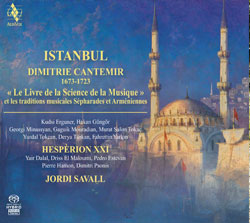
Istanbul ~~ Dimitrie
Cantemir (1673-1723)
Le livre de la
Science de la Musique
The Book of the Science of Music |
|
| |
Raices & Memoria, vol. IX |
|
| |
|
Description
Artistes / Performers :
Hespèrion XXI et
musiciens invités
Hespèrion XXI and invited
musicians
Lieu d'enregistrement / Recording site:
Collégiale de Cardona
Dates d'enregistrement: 02/2009
Recording dates: 02/2009
Durée totale / Total time: 73'03


ESTAMBUL. Dimitrie Cantemir:
"El libro de la ciencia de la música"
- Concierto de Jordi Savall

|
|
| |
|
|
|

Extrait du livret / From the liner notes |
|
ISTANBUL. DIMITRIE CANTEMIR
(1673-1723)
"Le livre de la Science de la Musique"
Au
carrefour des deux continents européen et asiatique, ISTANBUL pour
les Ottomans, CONSTANTINOPLE pour les Byzantins, est déjà à l’époque
de Dimitrie Cantemir (1673-1723) un véritable haut lieu de
l’histoire, malgré le souvenir et la présence très évidente de
l’ancienne Byzance, elle est devenue le véritable cœur du monde
religieux et culturel musulman. Mélange extraordinaire de peuples et
de religions elle attire toujours des nombreux voyageurs et artistes
européens, Cantemir y débarqua en 1693, à l’âge de 20 ans, d’abord
comme otage, puis comme représentant diplomatique de son père qui
gouvernait la Moldavie. Il devint un interprète fameux de
tanbur,
sorte de luth à long manche, et fût aussi un compositeur hautement
apprécié pour son ouvrage
Kitâb-ül ilm-il mûsikî
(Le Livre de la Science de la Musique)
qu’il dédia au sultan Ahmed III (1703-1730).
Tel est le contexte historique sur
lequel prend forme notre projet sur « Le
Livre de la Science de la Musique de Dimitrie Cantemir
et les traditions musicales séfarades et arméniennes ». Nous voulons
présenter les musiques instrumentales « savantes » de la cour
ottomane du XVIIe siècle, provenant de l’œuvre de Cantemir, en
dialogue et alternance avec les musiques « traditionnelles » du
peuple, représentées ici par les traditions orales des musiciens
arméniens et celles des communautés séfarades accueillies, suite à
leur expulsion du Royaume d’Espagne, dans des villes de l’empire
ottoman comme Istanbul ou Smyrne.
JORDI SAVALL
Edinburgh, Août 2009
Pour lire la suite -
cliquez ici
Recherchez ensuite:
CANTEMIR pour retracer l'enregistrement. |
ISTANBUL. DIMITRIE CANTEMIR
(1673-1723)
"The Book of the Science of Music"
At the time of
Dimitrie Cantemir (1673-1723), the city which stands at the
crossroads of the continents of Europe and Asia, ISTANBUL for the
Ottomans and CONSTANTINOPLE for the Byzantines, already marked a
veritable high point in history. Despite the memory and very
palpable presence of the old Byzantium, it had become the true heart
of the Muslim religious and cultural world. An extraordinary
melting-pot of peoples and religions, the city has always been a
magnet for European travellers and artists. Cantemir arrived in the
city in 1693, aged 20, initially as a hostage and later as a
diplomatic envoy of his father, the ruler of Moldavia. He became
famous as a virtuoso of the tanbur, a kind of long-necked lute, and was also a
highly-regarded composer, thanks to his work
Kitab-i ilm-i musiki
(The Book of the
Science of Music),
which he dedicated to Sultan Ahmed III (1703-1730).
Such is the historical context of our project on “Dimitrie
Cantemir’s The Book of the
Science of Music and the Sephardic and Armenian musical
traditions”. We aim to present the “cultivated” instrumental music
of the 17th century Ottoman court, as preserved in Cantemir’s work,
in dialogue and alternating with “traditional” popular music,
represented here by the oral traditions of Armenian musicians and
the music of the Sephardic communities who had settled in the
Ottoman empire in cities such as Istanbul and Izmir after their
expulsion from Spain.
JORDI SAVALL
Edinburgh, August
2009
Translated by
Jacqueline Minett
Read on...
Click
here
Than search for:
CANTEMIR to reach this
specific recording. |
|

Vol. 33:6 (Jul/Aug 2010)
|

|
Abonnement
Subscription |
Reviewer: Jerome
F. Weber
Abridged version-:
"Jordi Savall’s
continued interest in Mediterranean traditions brings him to
Sephardic and Armenian music centered in Istanbul and an author who
wrote The Book of the Science of
Music, a volume that he discovered as he was preparing his
earlier program Orient–Occident.
Dimitrie Cantemir (1673–1723) had two brief spells as Prince of
Moldavia but is better known as a leading intellectual of Eastern
Europe and the only one with a reputation known in the West. His
interesting background and career, told in the notes, need not be
summarized here, but he grew up at the Sultan’s court while his
father and brother were successive princes of Moldavia under the
Sultan’s protection. Succeeding as prince, he transferred his
allegiance to the tsar with disastrous results and spent his last 12
years in exile in Russia. His book contains 355 works, including
nine of his own compositions, all notated in a system of his own
devising. Seven works on this disc are
makam taken from this
source, another seven tracks are improvised preludes to each of them,
and the remaining seven tracks are devoted to Sephardic and Armenian
selections, the former drawn from Isaac Levy’s modern editions. Four
other makam from the same
book were heard in
Orient–Occident."
"While such an
extended concert of unfamiliar and exotic instrumental music can be
off-putting, repeated hearings become mesmerizing. The booklet
identifies three separate groups of players for Turkish, Armenian,
and Sephardic repertoire, but members of Hespèrion XXI are included
in all three groups... The 196-page
booklet is lavish in its display of art and manuscripts of the
period, photos of the performers, and the covers of the ensemble’s
previous productions. The surround sound adds to the appeal of the
production. Few labels are turning out such lavish albums as
consistently and regularly as Savall’s own."
|
Gramophone-
(07/2010) |
|
GRAMOPHONE
ARCHIVE
-
Texte intégral anglais
- Full text |
Subscription
Abonnement |
Reviewer:
Excerpt:
“The result is a very
polished, sophisticated sound world largely lacking the exuberance
that one might expect, at least on occasion, from such repertories,
but that in itself is a cue to the listener...that our expectations
of non-Western musics are easily confounded.”
|
|
Diapason- # 575
(12/2009)
|
 |
Appréciation

Evaluation |
Abonnement
Subscription |
Analyste: Roger
Tellart
Extraits:
"Jordi Savall et Hespèrion XXI avaient déjà eu un
premier contact heureux avec cette tradition du makâm dans
l'album "Orient-Occident" (c.f. nº
538).
Rencontre tout aussi réussie aujourd'hui..."
"À multiplier les concerts sur les thèmes chers aux diasporas
(amour,exil), Savall s'est fait bien des complices chez les
musiciens méditerranéens."
"Le résultat est un bonheur sonore de tous les instants, qui culmine
dans l'urgence poétique des makâms (ceux de la plage 8, à la
fois subtil et insistant, et de la plage 11). On souhaite une belle
carrière à ce nouveau produit de l'atelier savallien, toujours
inventif, toujours motivé..." |
Reviewer:
Abridged version :
|
|
|
|