|
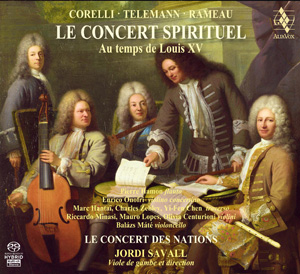
Le Concert Spirituel
Au temps de Louis XV |
|
|
|
Alia Vox AVSA9877
Code-barres/Barcode :
7619986398778 |
|
|
|
Description
Artistes / Performers :
Le Concert des Nations,
Jordi Savall, viole de gambe et direction
Lieu d'enregistrement / Recording site:
Collégial de Cardona (Catatalogne) (Catalunya)
Dates d'enregistrement: 16-19/02/2010
Recording dates: Feb.
16-19/2010
Durée totale / Total time: 78'29 |
|
|
 |
 Illustration de la pochette du disque:
"La Barre et d'autres musiciens" vers 1710, par André
Bouys (1656-1740)
Illustration de la pochette du disque:
"La Barre et d'autres musiciens" vers 1710, par André
Bouys (1656-1740) |
Artwork of the CD jacket:
"La Barre and other musicians" circa 1710, by André Bouys (1656-1740) |
|
Évaluations recensées / Reviews
located |
|

Awards
issue - 2010 |

#
583 (09/2010) |

# 125 (09/2010) |
|

34:4
(03/04-2011) |

Opus Haute Défénition
(Français & English) |

David Hurwitz |
|

Steven Ritter |

By:
George Pratt |
|

Par:
Thierry Hervé |
Passée des Arts
(08/2010) |
|

Le Concert Spirituel |

Concert Spirituel |
|
Extrait du livret / From the liner notes |
|
Les Goûts Réunis au Concert
Spirituel L'origine des Concerts privés, tant
en France que dans toute l'Europe, remonte à des temps
lointains dès que la musique, dépassant le cadre des églises
et des palais, fut aussi programmée dans les maisons
particulières et les jardins à l'air libre. C'est à la fin
du règne de Louis XIV que ceci commença à se produire à
Paris où "rien n'est si à la mode que la musique, passion
des honnestes gens et des personnes de qualité" comme
l'explique Huber Le Blanc (auteur du fameux pamphlet Défense
de la basse de viole, contre les entreprises du violon et
les prétensions du violoncelle, publié à Amsterdam, en
1740). Mais c'est durant la Régence que la première série de
concerts privés débuta avec les activités du cycle du
Concert Spirituel qui ne tarda pas à devenir célèbre. La
dénomination de Concert Spirituel provient du fait que ce
cycle fut créé afin d'organiser des concerts durant le
Carême et les fêtes religieuses catholiques. Ces fêtes
duraient environ trente-cinq jours par an pendant lesquels
toutes les activités "profanes" étaient paralysées dans les
principales institutions musicales et théâtrales, comme
l'Opéra de Paris, la Comédie Française et la Comédie
Italienne.
Pendant de nombreuses années, ces concerts eurent lieu dans
la Salle des Cent-Suisses, une salle magnifiquement décorée
du palais des Tuileries. Les concerts commençaient à six
heures de l'après-midi et étaient destinés principalement à
la grande bourgeoisie, à la petite aristocratie et aux
visiteurs étrangers.
JORDI SAVALL et JOSEP MARIA VILAR
~~~~~~~~
Poursuivez votre lecture - texte intégral
AV9877 :
Cliquez ici
The Goûts-réunis and the Concert
Spirituel
The origin of private concerts, both in France and the rest
of Europe, dates back to the time when music began to spill
out from churches and palaces to grace private houses and
open-air gardens. According to Huber Le Blanc (the author of
the famous pamphlet Défense de la Basse de viole, contre les
entreprises du violon et les prétensions du violoncelle,
Amsterdam 1740), in Paris at the end of the reign of Louis
XIV, “nothing was so fashionable as music, the passion of
the well-to-do and persons of quality”, but it was during
the Regency period that the first series of fully-fledged
private concerts, with the early activities of the soon to
be famous Concert Spirituel cycle began. The name Concert
Spirituel derives from the fact that it was created so that
concerts could be performed during Lent and on other
religious holidays of the Catholic Church, a total of some
thirty-five days each year, during which all the “profane”
activities of the principal musical and theatrical
institutions such as the Paris Opera, the Comédie-Française
and the Comédie-italienne, were brought to a standstill.
For many years, the concerts were held in the magnificently
decorated Salle des Cent Suisses (Hall of the Hundred Swiss
Guards) at the Tuileries Palace. Concerts started at six
o’clock in the evening and were principally intended for the
haute bourgeoisie, the minor aristocracy and foreign
visitors.
JORDI SAVALL & JOSEP MARIA VILAR
Translated by Jacqueline Minetti
Read on - Full text
AV9877:
Click here
|
|
Gramophone-
Awards
Issue - 2010
|
GRAMOPHONE
ARCHIVE
|
 |
Subscription
Abonnement |
Reviewer: Lindsay
Kemp
"Suave performances of music for an
18th-century French concert society"
Abridged version-:
« The
performances display characteristics typical of any under Jordi
Savall’s direction : richly toned, suave and confidently at ease
with the style. In Corelli’s Op 6 No 4 the concertino violins are
Enrico Onofri and Riccardo Minasi, whose fidgety genius and
uninhibited ornamentation ensure the music has its
required exciting finish. Teleman’s own Italianate side, with a dash
of his favourite Polish gypsy style thrown in, shows in the
attractive Concerto for recorder and viola da gamba, and Savall’s
solo gamba is helped out by two thickly buzzy orchestral colleagues
in a French-style overture-suite. A jaunty suite from the Tafelmusik
collection features a larger concertino of two
flutes , two violins and a cello in a relaxed and affable interplay,
and the disc rounds off with a short suite of dances from Rameau’s
Les Indes Galantes, here lacking the spirit of some other
Rameau performances maybe but still engaging enough to make one wish
they had chosen
to record more. The sound is on the boomy side and Savall makes his
usual near-articulate moaning noises, but neither is more than a
minor distraction.” |
|
Diapason- # 583
(09/2010)
|
 |
Appréciation

Evaluation |
Abonnement
Subscription |
|
Analyste: Jean-Luc
Macia
Résumé ou abrégé:
"Le disque, ..., est un album Telemann
déguisé: apprécions-le comme tel, en oubliant ce faux titre.
Apprécions le somptueux Concert des Nations dans la Suite avec
viole de gambe (tenue par maestro Jordi himself,
éblouissant). TW 55/D6, le sublime Concerto pour flûte à
bec et viole de gambe TWV 52/a1 (Pierre Hamon à la flûte) et
l'Ouverture extraite de la première partie de la Tafelmusik,
celle avec deux traversières solo (Marc Hantaï, Charles Zebley),
leurs rythmes acérés, leurs sonorités épanouies, leur verve
décorative (irrésistible Trompette de la première Suite),
leurs galanteries jamais mièvres. Trois lectures voluptueuses
encadrées donc d'un Corelli vibrant, parfois précipité, aux solos
assez modestes, et d'un Rameau bigarré et jouissif quoique pas
toujours idiomatique. À classer à Telemann". |
|
Classica- # 125
(09/2010)
|
  |
Appréciation:

Evaluation:
|
Abonnement
Subscription |
Analyste: Jean-Moël Coucoureux
Texte intégra; (cliquer
ici):
Jordi Savall en son palais
"Décidément, tout ce que
touchent Jordi Savall et le Concert Des Nations devient or. Ici se
conjuguent authenticité et joie de jouer. " |
|
34:4 (03/04-2011)
|
 |
Abonnement
Subscription |
Reviewer:
Abridged version :
"Savall has long been known not only for
his smart thematic programming but more importantly for his emphasis
on sensual tone while giving free rein to a score’s dance rhythms.
Take the Corelli, with its highly lyrical, Italianate opening
passage succeeded by the quick, nimble interplay of the concertino
violins. In the Telemann Suite for Gamba and Strings, even the
ouverture
feels like part of a dance suite rather than a pompous introduction
set apart from the dances that follow, and Savall is a rollicking
soloist. And so on all the way through to the end of the Rameau
suite, which enjoys a particularly vibrant performance. Overall,
Savall and company provide intricate ornamentation and their
customary Mediterranean warmth and vivacity without resorting to the
mania increasingly common among Italian and some French ensembles.
"
"This
generously filled disc, in the label’s typically gorgeous
high-resolution audio, is a perfect introduction to Baroque
orchestral music beyond Bach, Handel, and Vivaldi, and a highly
desirable acquisition for more seasoned collectors. After hearing
this, many music lovers will surely call for Savall to record all
the Corelli concerti, and make a more comprehensive survey of
Rameau’s opera-ballet suites. And who knows what further Telemann
treasures they could turn up?"
This article is
available on the web to
subscribers of Fanfare. |
|
| |
Autres références disponibles via la base de
données de Todd McComb/ Other available references via
Todd McComb's database:
(Site: http://www.medieval.org)
Re:
Alia Vox AVSA 9877 |
|
|
|
|
To order / Commander
Alia Vox AVSA9877
Code-barres/Barcode
:
7619986398778
 |
|
La viole de
gambe
Parutions
récentes |
Viola da gamba
Recent
releases |