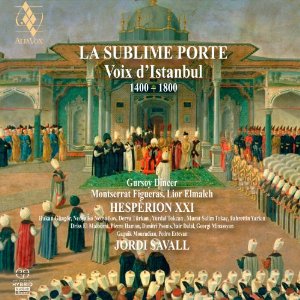
Ces « Voix d'Istanbul », avec des œuvres vocales et des
musiques instrumentales (ottomanes, grecques, sépharades et
arméniennes), autour de « La Sublime Porte » (ou la cour ottomane
de cette «Porte de la félicité »), font suite à notre premier
enregistrement dédié aux musiques instrumentales de l'Istanbul
ottoman, sépharade et arménien du temps de la publication du «
Livre sur la Science de la Musique » du prince moldave Dimitrie
Cantemir. Durant les multiples recherches que nous avons dû faire
sur la musique, la culture et l'histoire des Turcs, nous sommes
devenus de plus en plus conscients de l'étonnante ignorance que
l'on a en Occident sur l'histoire et la civilisation ottomane.
Comme le signale si bien Jean-Paul Roux dans son Histoire des
Turcs « Nous en savons plus sur les Turcs que nous ne l'imaginons,
mais rien ne relie nos connaissances ». De l'école, nous gardons
le souvenir qu'en 1453, ils prirent Constantinople, que Soliman le
Magnifique fut l'allié de François Ier contre l'hégé-monie de
Charles Quint, ou qu'en 1572 la flotte des nations chrétiennes
infligea une terrible défaite aux Turcs à la bataille de Lépante.
Le grand Miguel de Cervantès, qui perdit sa main gauche à Lépante,
évoque magistralement pour nous le monde ottoman dans La gran
sultana (1615). Par Racine nous connaissons le sultan Bajazet ;
par Molière et son Bourgeois gentilhomme, les « turqueries » qui
seront encore à la mode au XVIIIe siècle. La liste des auteurs qui
nous ont fait rêver sur le monde et les légendes ottomanes est
longue ; de Théophile Gautier à Anatole France, de Lully à Mozart,
de Pierre Loti à Victor Hugo, sans oublier les phrases de
Lamartine ou de Nerval, certaines peintures d'Ingres et de
Delacroix… et les tapis Bellini, Lotto, Holbein fabriqués en
Turquie aux XVe, XVIe et XVIIe siècles. Nombreuses références
originaires du mode de vie et des objets turcs font partie de
notre quotidien ; les kiosques, petits pavillons que les Turcs
nomment köşk. La tulipe, importée du Bosphore par les Hollandais,
prend son nom de sa forme de turban tülbent. Nous mangeons souvent
turc, et pas seulement les brochettes que les Turcs nomment şiş
kebap (chich-kebab). Le goût du café et des croissants (avec la
forme de l'emblème qui ornait le drapeau des assiégeants) est
devenu à la mode après un siège de Vienne par les Ottomans, et le
yoghourt (yoğurt), défini comme « mets national des montagnards
bulgares », est connu depuis toujours chez les nomades des steppes
et son nom dérive des expressions turques yoğun « dense ou épais »
ou Yoğunluk « densité » et yoğurtmak « pétrir». Dans notre
imaginaire il y a aussi les mots sérail, harem, odalisque,
cimeterre, les tableaux des orientalistes, le vent des sables…
Ainsi passons-nous d'un répertoire de faits assez mal connus à une
succession de visions irréelles, plus ou moins transformées au gré
de notre fantaisie…
Mais la réalité est autre. Les Turcs, ce sont deux mille ans
d'histoire, s'étendant du Pacifique à la Méditerranée, de Pékin à
Vienne, à Alger, à Troyes. Ils ont mêlé leur destin à celui de
tous les peuples de l'ancien monde, ...
JORDI SAVALL
Bâle 19 septembre 2011
~~~~~~~~~~~~~~
These “Voices of Istanbul”, comprising vocal
pieces and instrumental music (Ottoman, Greek, Sephardic and
Armenian) from the “Sublime Porte” (the Ottoman court of that
“Gateway to Happiness”), follow our earlier recording devoted to
the instrumental music of Ottoman, Sephardic and Armenian Istanbul
from the time of the publication of The Book of the Science of
Music by the Moldavian prince Dimitrie Cantemir. During our
lengthy research on the music, culture and history of the Turks,
we have become more and more aware of the West’s astonishing
ignorance regarding Ottoman history and civilisation.
As Jean-Paul Roux so aptly points out in his Histoire des Turcs,
“We know more about the Turks than we might imagine, yet nothing
binds that knowledge together”. From our schooldays we recall that
in 1453 they took Constantinople, that Suleyman the Magnificent
was the ally of Francis I against the hegemony of Charles V, that
in 1572 the combined fleet of the Christian nations inflicted a
terrible defeat on the Turks at the Battle of Lepanto. The great
Miguel de Cervantes, who lost the use of his left hand at the
Battle of Lepanto, provides a magnificent evocation of the Ottoman
world in his play La gran sultana (1615). Thanks to Racine we are
familiar with the sultan Bajazet; through Molière and his
Bourgeois gentilhomme, we discover the “Turqueries”, or
Turkish-inspired fashion and décor, which were still fashionable
in the 18th century. A long catalogue of writers and artists have
fed our dreams of the Ottoman world and its legends: from
Théophile Gautier to Anatole France, from Lully to Mozart, from
Pierre Loti to Victor Hugo, without forgetting the poetic
evocations of Lamartine and Nerval, the paintings of Ingres and
Delacroix… and the Bellini, Lotto and Holbein carpets produced in
Turkey in the 15th, 16th and 17th centuries. Numerous references
deriving from the Turkish way of life and objects form part of our
everyday lives; kiosks, the small pavilions that the Turks call
kösk; the tulip, imported from the Bosphorus by the Dutch, takes
its name from the shape of the turban tülbent. Turkish food often
features in our diet, not only the brochettes that Turks call
shishkebab (şiş kebap), but also our taste for coffee and
croissants (in the shape of the emblem, the crescent moon, which
were emblazoned on the standards of the besieging army), which
became fashionable following a siege of Vienna by the Ottomans,
and yoghurt (yoğurt), defined as “a national food of the mountain
dwellers of Bulgaria” but which has always been a staple of the
nomads of the steppes, the word itself deriving from the Turkish
expressions yoğun (“dense” or “thick”), or yoğunluk (“density”),
and yoğurtmak, meaning “to knead”. Our imaginary is also furnished
with words such as seraglio, harem, odalisque, scimitar, with
Orientalist paintings and desert winds… Thus, we progress from a
repertoire of imperfectly known facts to a succession of unreal
visions that have been more or less transformed at the whim of our
imagination…
The reality is quite different. The Turks can boast two thousand
years of history, from the Pacific to the Mediterranean, from
Peking to Vienna, Algiers and Troyes, during which they have
welded their destiny to that of virtually all the peoples of the
ancient world
JORDI SAVALL
Basel, 19th September 2011
Translated by Jacqueline Minett