Traduction".
Texte paru dans: / Appeared in: |
|||||||
|
|
|||||||
|
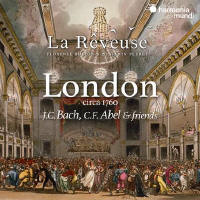
Anyone as fascinated by the social history into which music is composed as they are in the music itself is going to relish the portrait of c1760 London as painted by French period band La Rêveuse in this third instalment in their series devoted to the British capital. So far we've had 1720 and Corelli's legacy, and 1740 focusing on Handel's musicians. Now we have England basking in its recent Seven Years War triumphs, while enjoying being artistically invaded by the galant-style composers flocking across the Channel with hopes of impressing the musically discerning new (German) Queen Charlotte.
It's a story of enterprising virtuosoimpresarios, chief among whom were Carl Friedrich Abel and Johann Christian Bach, whose circle in turn included Scottish violinist and 6th Earl of Kellie Thomas Erskine (who had studied in Mannheim under Stamitz), lutenist Rudolf Straube, painter Thomas Gainsborough and 'Sensibility'-movement writer Laurence Sterne; and on the bottom end of the virtuosic scale, the sentimental, simpering
femininity of Ann Ford, the singer and multi-instrumentalist famously painted by Gainsborough. It's also a story of chaotic, scandal-spiced concert contexts such as magnificent, Chippendale-decorated Carlisle House, where Venetian actress, singer and courtesan Teresa Cornelys hosted decadent masked balls frequented by cabinet ministers and the aristocracy, at which a 7-9pm concert from London's finest musicians preceded revels including the sort that required little upstairs booths with beds; or the Pantheon in Oxford Street, where the bacchanalian parties lasted until morning. 'These [concerts] were not for those who preferred silent, meditative audiences', stresses La Rêveuse gambist Florence Bolton in her entertaining booklet note.
The album's programme translates this noisy, musically multifaceted portrait into a correspondingly kaleidoscopic stylistic cornucopia which, beyond the usualsuspect instruments for recordings covering this period (violin, viol, traverso, harpsichord, etc) also features the Ann Ford-inspired flashes in the pan, the English guitar and musical glasses (glasses tuned to various pitches, played by running fingers around the rims). Less corresponding is the smoothly flowing finesse and soft-hued decorum with which it's all performed even if it's not without spirit. One programme highlight is the lively Allegretto from Abel's Quartet in G, Serge Saitta's traverso flying smoothly through its high-register somersaults, and an absorbingly suave, democratic balance and blend between the instruments.
There's an equally soft-polished blend to Abel's Viola da gamba Concertata in G (a 2020-published reconstruction from a cello concerto in B flat and a Flute Concerto in C), captured so as not to place the soloist's dulcet timbres unnaturally forward over its more powerful string counterparts.
The album's most gorgeous discovery for me has been the pieces for English guitar by Geminiani and Straube, two very different musical voices sounding thoroughly sublime through Benjamin Perrot's shaping and shading. The two pieces from Ann Ford's musical glasses method book, pairing the pure-chiming glasses with airy traverso, leave no room for wondering why her stage career was so short-lived. By crumbs, it's twee. Also fascinating. But JC Bach's more upbeat Quartet in D would surely have played the programme out on more of a high.
Essentially, while the programme may pay tribute to London's concert scene at its noisiest and bawdiest, in execution we're in Versailles. I've just now looked up my reviews of this album's aforementioned precursors, and see I remarked both times on the soft, French elegance. This time it feels slightly more at odds with the context. That said, it's still very attractive. |
|||||||
|
|||||||
|
|
|
||||||
|
Cliquez l'un ou l'autre
bouton pour découvrir bien d'autres critiques de CD |
|||||||