Texte paru dans: / Appeared in:
*
International Record Review - (07/08 - 2011)
Pour
s'abonner / Subscription information
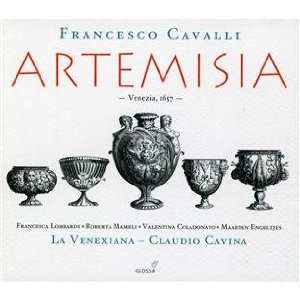
Glossa
GCD920918 (3CD)
Abridged version:
Artemisia is a beautifully balanced score, in which every aria is justified by the action (rather than pandering to audience greed), and is perfectly suited to its context: short and sweet when the drama needs to move on; longer and more developed when an important emotion needs to be explored.
Another feature of Cavalli’s writing which may surprise those of us steeped in eighteenth-century operatic practices is the freedom and rapidity with which the music moves from matter-of-fact recitative, through passages of more declamatory or lyrical material, to a few lines of aria-like writing ... all the way to a full-blown aria. Arias, in turn, may be interrupted by recitative, and whole scenes may be shaped by recurring instrumental or vocal ideas. In short, the hardening of the categories between recitative and aria found in later opera seria is delightfully absent here. In Artemisia Cavalli‘s music is exceptionally responsive to the rhythms, grammar and imagery of the text, and the rapid changes of style, and its sheer unpredictability, really draw one into the drama.
If only that drama was easy to follow....
The performance
recorded here is nothing less than a triumph. Before going into the studio
Claudio Cavina and La Venexiana gave the opera a good run at the Hannover
Herrenhausen and Montpellier Festivals in June and July last year. Their
familiarity with, and affection for, the work shows most obviously in the
captivating way they project the drama and inhabit the characters. Most of
this opera is notated in just two parts — voice and bass — with no harmony,
expressive indications and precious little independent instrumental writing.
So the challenge is to animate and amplify the bass with a battery of
continuo instruments and let a fluid pace evolve to match the unfolding
drama, which they do with finely judged changes of continuo timbre and
tempo.
The overall feel here is small-scale. In the past, conductors who did so much to promote Cavalli, like Raymond Leppard in the 1960s and 1970s and René Jacobs in the 1980s and 1990s, had to contend with large modern opera houses (and different audience expectations) and so they employed quite large instrumental ensembles and ‘enhanced’ the long stretches of simple continuo support with their own instrumental accompaniments.
Cavina keeps things modest and intimate, in keeping with the tiny seventeenth-century Venetian opera houses, using single strings and trusting in the original continuo textures. Above all, he shows us just how telling an apparently simple bass line can be, offering ‘melodic comment’ on what’s being sung, hinting to us whether a character is lying or keeping a secret. We are drawn in.
Cavina’s choice of singers is perfectly matched to the scale of the production. Soprano Francesca Lombardi Mazzulli captivates us from the very start with the part-panted, part-declaimed, part-sung lament which follows hard on the heels of the opening Sinfonia. (And, oh, the sheer agonizing, delicious, wicked painfulness of the music.) Mazzulli is a good actress who excels at Cavalli’s liquid recitatives, with their constantly changing balance of melody and declamation. It’s a voice which can be steely, vulnerable, pathos-laden, joyous and deceitful — all without over-singing or drenching the vocal lines with vibrato — but she doesn’t get the most obviously attractive music. In Cavalli’s operas the distribution of melodic material is closely linked to a character’s social status. So it’s the minor characters and low-born who run off with all the good tunes — like the servant Eurillo, sparklingly sung by pin-point soprano Silvia Frigato. She’s excellent in the only example Cavalli ever penned of an echo aria (the minute- long ‘Fortunato, che piegato’) and it sounds as though she recorded the telescoped double echoes too (edited in later). High tenor Alberto Allegrezza does a charming turn as the stock ageing nursemaid duped into trying some dodgy anti-ageing cream by Eurillo and Niso (sung deadpan by countertenor Alessandro Giangrande). The comedy is actually very lightly done, allowing unexpected hints of melancholy to emerge from Cavalli’s music. 0f the other minor characters, bass Salvo Vitale stands out as Artemisia’s tutor — delivering words of wisdom with real sincerity and tonal warmth.
Countertenor Maarten Engeltjes plays the love interest, Meraspe, with a Michael Chance-like thinness of tone. It’s brilliant. Meraspe is powerless to act on his love for Artemisia and his tortured soul is effectively bared through Engeltjes’s wide palette of sad colours. Yet he can change in an instant, as in the glorious lullaby (with plucking strings) which he sings to the sleeping Artemisia in the final act. Some of the most rewardingly lyrical writing is given to Artemia and Ramiro (who eventually get together). Soprano Roberta Mameli gets the longest and most polished aria in the score, ‘Ardo sospiro’, which comes complete with a very rare sustained string accompaniment throughout. Some will remember Janet Baker singing this aria, which Raymond Leppard transplanted into his recording of Calisto in 1970. Mameli uses much less lung power and internalizes her grief, and there’s something abotit her uneven rates of (delicately applied) vibrato which I find especially affecting.
Last year Cavina and La Venexiana enjoyed courting
controversy with their shake-up of Monteverdi’s Coronation of Poppea
(reviewed in May 2010). With Artemisia they return to relative orthodoxy,
their only audible liberties couple of rather lovely passages of pizzicato
and an unlikely, though gorgeous, harp among the continuo pluckers. With
such a complex plot and long cast list the accompanying booklet should
really offer a detailed synopsis, but if you read Schulze’s essay very
carefully you can pick up most of what you need. This is my only
reservation. Otherwise, this is an important release and one of the most
convincing recordings of a Cavalli opera done to scale that I’ve heard. It
contains some breathtakingly beautiful music, which, because of the opera’s
structure, is much less easy to ‘get at’ than in recordings of later operas,
where, one just heads for the aria tracks. Here we must listen to much more
of the opera than we might otherwise do and the rewards are outstanding.
Cliquez l'un ou l'autre
bouton pour découvrir bien d'autres critiques de CD
Click either button for many other reviews