Texte paru dans: / Appeared in:
*
International Record Review -
Pour
s'abonner / Subscription information
Musique en
Wallonie
MEW1054
5425008310541
Consultez toutes les évaluations recensées pour ce cd
~~~~ Reach all the evaluations located for this CD

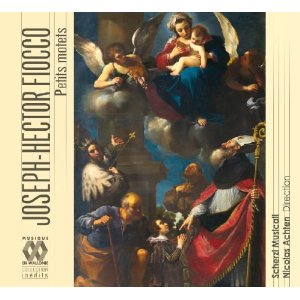
Baroque music from the Catholic parts of The Netherlands (now mostly comprising Belgium) is still little known today. The small but high-quality label Musique en Wallonie is helping to redress this situation. Having already released two discs of music by Pietro Antonio Fiocco, it now issues a volume of sacred works by his slightly better known son Joseph-Hector Fiocco (1703-41). Fiocco senior was a Venetian composer who ultimately made his career in Brussels, where Joseph-Hector was born: one of 14 children by two wives, Fiocco junior was a professor of Greek and Latin, as well as a harpsichordist and organist of some note, and his Pièces de clavecin, published in 1724, are his most famous works. Ewald Demeyere has made an excellent complete recording on Accent.
However, the bulk of Fiocco’s compositions consisted of sacred music composed for cathedrals and churches in Antwerp and Brussels. His works in this field were also well known and admired in Paris. Fiocco ‘s excellent Lamentations for Holy Week are also moderately well known today. Ann Mertens’s selection on Eufoda is slightly to be preferred to Greta de Reyghere’s and Jan Van der Crabben’s on Et’Cetera. The Naxos recording of his Missa solemnis features some excellent singers but, regrettably, uses a modern-instrument orchestra.
Into this not very crowded field now comes a recording of such outstanding quality that it should win Fiocco many new admirers. The driving force behind the project is the young Belgian musician Nicolas Achten. He is what is sometimes called a Renaissance Man, but perhaps should be called a Baroque Man. Director of the ensemble Scherzi Musicali, Achten is a baritone possessed of an extremely lovely voice, an expert researcher into old music and a harpsichordist who also plays the lute, harp and theorbo. He is also one of few modern (non-pop or folk) performers who practises the old art of self accompanied singing. Scherzi Musicali has mostly specialized in seventeenth-century music, notably its wonderful recordings of Caccini’s L’Euridice and Sances’s motets on Ricercar. A forthcoming release on Alpha is of Mazzochi’s La Catena d’Adone.
With Fiocco’s Petits Motets,
Scherzi Musicali moves firmly into late-Baroque territory and to music
which, as Achten points out in his notes, is stylistically hard to pin down.
The term ‘petits motets’ implies music in the French manner, but the voice
types are given Italian descriptions. Then again, their tessitura
corresponds more to French patterns, for example, the alto parts range is
more suited to an haute-contre than a contralto or countertenor. The vocal
tessitura plus the diapason and timing of Southern Netherlands organs have
led Achten to adopt a low pitch (A=388) and a mean-tone tuning with pure
thirds. The motets are scored for small forces: between one to four voices
plus a tiny string ensemble and continuo.
Even Fiocco ‘s continuo directions reflect the mixed French and Italian
influences: in some motets the Italian cello is preferred, in others the
French basse de violon. These are supplemented with organ,
harpsichord and triple harp. On the whole, the works sound more Italian than
anything else - the opening of Libera me Domine, for example, is very
Vivaldian — but there are, as Achten points out, also occasional
reminiscences of Couperin, Charpentier and Lully. The vocal writing is
elegant, melodically strong and, in the solo sections, often very fond. The
young fresh-voiced singers of Scherzi Musicali are more than equal to these
challenges. With historically informed singing in so parlous a statw these
days, it is refreshing and reassuring to hear such expert and stylistically
aware sopranos as Céline Vieslet and Marie de Roy, who each has a solo
motet, as well as the baritone Olivier Berten and, of course, Achten
himself. Perhaps the stand-out singer, not only in his solo motet
Jubilate Deo but also throughout the programme, is the haute-contre (or
high tenor) Remoud Van Mechelen, whose timbre and agility resemble those of
the young Guy de Mey. He is a major talent of whom I am sure we will be
hearing much more in the future. The ensemble’s instrumentalists are also
marvellously alert and skilful in Fiocco‘s quite intricate but always
buoyant writing.
Musique en Wallonie has given the project
an amply documented and illustrated hardback CD book as well as a crisp and
airy recording in the Église de Sart-lez-Spa (a village in Wallonia). This
is an enterprising and outstanding release.
Cliquez l'un ou l'autre
bouton pour découvrir bien d'autres critiques de CD
Click either button for many other reviews