Traduction".
Texte paru dans: / Appeared in: |
|||||||
|
|
|||||||
|
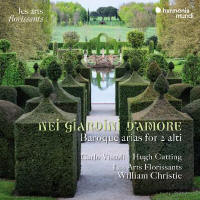
Reviewer : Edward Breen Carlo Vistoli and Hugh Cutting make for superb duet partners and keen communicators on this new album of Baroque arias, on which they also each have a solo cantata offering plenty of textural variety. Their impressively dramatic performances contain deliciously modest moments leading to music-making of great subtlety. Added to this, the instrumental playing is so superb as to nearly steal the show, as listeners will immediately note from the tempting sway of Monteverdi’s ‘Damigella tutta bella’.
Caldara’s Medea in Corinto, an early cantata written after 1709, is presented here by Vistoli. A Venetian who lived between Italy and Austria, Caldara ultimately served as vice-Kapellmeister to the Habsburg court in Vienna, but as a contemporary of Vivaldi he is still under-represented on recordings today. Medea in Corinto was presumably written for his wife (a contralto), and the story begins just as Medea realises she will be abandoned by Jason; thus there are moments of fury that suit Vistoli very well, since dramatic presence, quick-fire recitative and particularly fine coloratura are well within his remit. His performance is gripping right the way through and makes an interesting comparison with Gérard Lesne (Erato, 11/91), who takes a more smouldering approach to Medea’s rage. Separating this solo cantata from the next is Handel’s Trio Sonata in C minor, from which Christie coaxes a wonderful throbbing heartbeat right from the start.
Cutting sings Vivaldi’s cantata Cessate, omai cessate, which follows a standard Italian cantata structure with two recitative-aria pairs. Cutting I find warmer-toned and more exuberant than Scholl (Harmonia Mundi, 4/96), and he is also more closely recorded, which showcases the even tone he has throughout his range. Still, I favour the recording by Tim Mead (Alpha, 3/23), largely due to the second aria, ‘Ah ch’infelice sempre’, and its juxtaposition of smooth vocal line with pizzicato violins – a contrast that is slightly too brittle for my taste in Christie’s interpretation.
As for the main duets, Bononcini’s Sempre piango compares favourably with the recording by La Venexiana (Glossa, 2/18) due to these singers’ greater ease with the demanding range. Here, after the lamenting cello line, Vistoli and Cutting present a first duet dripping with emotion and clever contrast. Handel’s later version of Caro autor di mia doglia rather magnificently sounds as if it starts in the middle of a conversation due to its restless bass line, and the fiendishly difficult last duet is both exhausting and exciting in this performance. This is indeed an album of incredibly impressive singing and – as ever from William Christie – a well-wrought programme. |
|||||||
|
|||||||
|
|
|
||||||
|
Cliquez l'un ou l'autre
bouton pour découvrir bien d'autres critiques de CD |
|||||||