Traduction".
Texte paru dans: / Appeared in: |
|||||||
|
|
|||||||
|
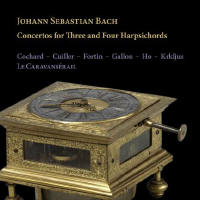
Reviewer : Jonathan Freeman Attwood The re-creational spirit underscoring Bach's harpsichord concertos offers the listener a particularly keen sense of the composer's penchant for refashioning existing material. Mainly trawled from violin concertos and recycled for his sons and students (including during the periods he was directing the Collegium Musicum in Leipzig in the 1730s), Bach - ever the didact - was no slouch in forging the solo parts to match the ability of the players. In the slipstream of such reimagining, Bertrand Cuiller plays Bach at his own game in the final work, a resonant account of Brandenburg Concerto No 3 for four solo harpsichords.
The discreet single-string ensemble (the most practical and likely historical configuration) of Le Caravansérail is skilfully balanced here with the intricacies of the multi-keyboards, and yet any potential litheness - especially in the threeharpsichord concertos - is often lost to rhythmic homogeneity and incessant evenness. A strong textural presence is inevitable in such scoring but that's where the best performances match it with variety of melodic shape, buoyancy and a degree of allure in the string-writing. Lars Ulrik Mortensen remains the benchmark in all these respects.
The outer movements of the C major Concerto too easily tend towards a downward gravity, shorn of an easy elegance and joy that spring from Bach's pen in this finely chiselled oeuvre. Likewise, despite the highly accomplished and virtuosic playing in the D minor Concerto, an unyielding conceit even pervades the radiant second movement in its over-regulated phrasing. In this exquisite Arcadian essay, one longs for a more gentle and assuaging conversation between the soloists. The account of the four-harpsichord Concerto 'after Vivaldi' (from his Op 3 No 10) finds the happiest of collaborative solutions, but it's the adventurous transcription of the Brandenburg Concerto which turns the tables on misgivings about the rather dogged music-making elsewhere. It's pacy, immense fun and deserves many outings. |
|||||||
|
|||||||
|
|
|
||||||
|
Cliquez l'un ou l'autre
bouton pour découvrir bien d'autres critiques de CD |
|||||||