|
El
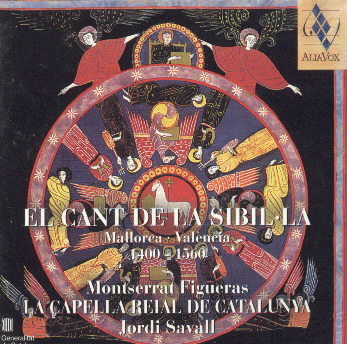
Cant de la Sibil-la
Mallorca ~ València
1400-1560 |
|
|
|
Alia Vox AV9806
Code-barres/Barcode:
7619986098067
|
Alia Vox AVSA9806
Code-barres/Barcode:
7619986398068
|
|
 |
Description
Artistes / Performers
Montserrat Figueras,
La Capella Reial de Catalunya
Direction: Jordi Savall Lieu d'enregistrement / Recording site: Collégiale du Château de Cardona
(Catalogne) (Catalunya) Dates d'enregistrement: 28-30
juin et 1-2 décembre 1998
Recording dates: June 28-30 &
December 1-2, 1998 Durée totale / Total time: 61
' 38

|
|
|
|
|
|

(Hybrid-SACD)
|

(Hybrid-SACD)
MP3
|

(Hybrid-SACD)
MP3
|

(Hybrid-SACD)
MP3
|
|

(Hybrid-SACD)
|

(Hybrid-SACD)
|

(Hybrid-SACD)
MP3
|

(Hybrid-SACD)
MP3
|
|
|
 |
|
 Montserrat Figueras et La
Capella Reial de Catalunya nous reviennent avec un nouvel
enregistrement consacré aux Chants de la Sybille, provenant
cette fois-ci de Majorque et de Valence.
Montserrat Figueras et La
Capella Reial de Catalunya nous reviennent avec un nouvel
enregistrement consacré aux Chants de la Sybille, provenant
cette fois-ci de Majorque et de Valence.
|
Montserrat Figueras and the Capella Reial
de Catalunya return with a disc
of two further Songs of the Sibyl, from Majorca and Valencia.
|
|
Évaluations recensées / Reviews
located |
|

11/1999
|

#459 05/1999 |

# 14 07-08/1999 |
|

23:1 (09-10/1999) |

# 8 (08-1999)
|

Reviewer: Garry S. Dalkin

Reviewer:
Gerald Fenech
|
American Record Guide
March 2000
by:
John W. Baker
|
 |
|
|

Sibylle |

Sibyl |
|
Extrait du livret / From the liner notes |
|
Paru en 1999, ce nouveau volume des Chants
de la Sibylles constituait déjà le troisième opus de cette série
d’enregistrements commencés chez Auvidis en 1988. Dès sa sortie,
la critique a salué cette nouveauté et le public, fasciné par ces
superbes œuvres venues du fond des temps ne s’est pas lassé et à
suivi fidèlement ces nouvelles découvertes.
Pour rappel, les premières traces des Sibylles remontent à la fin
du VIè siècle avant JC. Êtres semi-divins, elles sont capables de
prédire les événements futurs et possèdent des pouvoir
divinatoires. Les premiers chrétiens ont récupéré ce mythe comme
oracle de la seconde venue du Christ pour le jugement dernier et
la fin du monde. Cet élément mythologique va perdurer dans
l’histoire jusqu’au Moyen-Age et même à la Renaissance. A
l’origine en version latine, les Sibylle étaient chantées par un
jeune garçon déguisé en femme durant les Matines de Noël ou
pendant la Semaine Sainte, en France, Italie et surtout dans la
péninsule ibérique à partir du Xè siècle. Au cours du temps, des
éléments musicaux de la tradition populaire vont s’intégrer aux
versions originales sobres et profondes et à partir du XIIIè
siècle, les Sibylle vont se célébrer en langue populaire. Elle
tombèrent toutefois en désuétude au XVIIIè siècle, bien que la
tradition continue encore aujourd’hui en certains endroits
(notamment à Majorque) où les Sibylles sont encore chantées la
nuit de Noël, avant la Messe de Minuit. |
|
Released in 1999, this is the third volume of
“Songs of the Sibyls”, a series of recordings begun with Auvidis
in 1988. It has won praise from the critics and the record-buying
public, fascinated by these superb works from a long-distant past,
have eagerly awaited each new discovery.
The origins of the Songs of the Sibyls date back to the 6th
century BC. Semi-divine beings, their oracular powers
enabled them to predict the future. The myth of the sibyl
was appropriated by the early Christians to prophesy the
second coming of Christ, heralding the last judgment and the
end of the world. This mythological element survived as late
as the Middle Ages and even the Renaissance. Originally sung
in Latin, the Songs of the Sibyls were traditionally
performed by a young boy disguised as a woman during Matins
on Christmas Day or during Holy Week in France, Italy and
especially the Iberian Peninsula from the 10th century. Over
time, traditional elements of popular music were added to
the profoundly austere original versions and from the 13th
century, the Sibyls were sung in the vernacular. They fell
into disuse in the 18th century, although the tradition is
still alive in certain areas (particularly Majorca, where
the Songs of the Sibyl are still sung before Midnight Mass
on Christmas Eve).
|
|
Gramophone-
11/1999
|
GRAMOPHONE
ARCHIVE
|
Subscription
Abonnement |
|
Analyste: Mary
Berry
Condensé (traduction libre):
Mary Berry se contente d'une seule phrase fort laconique pour
apprécier ce disque: "The singing of the stanzas is dramatic and
the use of instruments discreet."
Son article fait surtout référence aux sources utilisées pour la
reconstitution de ces chants de la Sibylle. Celui de la Sibylle
majorquine provient d'une version en catalan du Livre de choeur du
Couvent de la Conception, à Palma (île de Majorque). Celui de la
Sibylle valencienne est basé sur l'harmonisation à quatre voix du
refrain effectuée par Bartolomé Cárceres au milieu du 16e
siècle.
L'auteur mentionne que la Procession des Prophètes a longtemps fait
partie de la liturgie de Noël. Le chant de la Sibylle, tout
spécifiquement à Valence, était interprété par un enfant de
choeur déguisé en femme ou dans les monastères, par une jeune
nonne. Ce personnage était le dernier de la Procession des Prophètes
à défiler devant les fidèles. Le tout se déroulait dans le cadre
des matines de Noël.
|
|
Reviewer: Mary
Berry
Abridged Text:
"Who has not heard with some curiosity that fleeting
reference to the Sibyl at the beginning of the
Dies irae
in the Requiem Mass: ‘Dies irae, dies illa ... teste David cum
Sibylla’? Yet, just as the Procession of the Prophets used to be
a familiar feature of the Christmas liturgy all over Europe, so
the
Song of the Sibyl
was formerly sung with great solemnity, in some of the great
Spanish cathedrals and monasteries. A boy chorister or a young
novice performed the part during the Office of Christmas Matins.
Indeed, it can still be heard today in Majorca, on Christmas Eve,
in the cathedral of Palma and elsewhere. This recording presents
in parallel two versions of the
Cantus Sibille
, one taken from the Catalan version found in a fifteenth-century
choirbook from the Convento de la Concepcion in Palma, the other,
a reconstruction based on a four-part, harmonized version of the
refrain from the mid-sixteenth century Bartolome Carceres, the
text and the music of the stanzas culled from various Catalan
sources".
|
|
Diapason- # 459
05/1999
|
 |
Appréciation

Evaluation |
Abonnement
Subscription
|
|
Analyste:
Roger Tellart
Résumé ou abrégé:
Roger Tellart, décerne un Diapason d'Or à cet enregistrement des chants de
la Sibylle et pour cause.
En regard du chant de la Sibylle majorquine, tel que rendu par
Montserrat Figueras, Tellart écrit: que celle-ci "... libère
son chant sur les tenues mystiques de la lira de Jordi
Savall: un chant qui tourne au message magique, tellurique..."
Quant au choeur de la Capella Reial de Catalunya, "... il
s'abîme dans une attitude dévotionnelle d'une incroyable
intensité",
Par ailleurs, Tellart perçoit le chant de la Sibylle valencienne
comme étant plus "policé". Mais il ajoute que " ...
la vision d'éternité de l'oracle, partagée une fois encore entre
les solos habités de Montserrat Figueras.... se révèle tout aussi
captivante et prenante".
En somme, cet enregistrement nous convie à "... d'obsédants
moments d'adoration et de musique arrachés à la nuit des temps par
des interprètes à l'intuition sans pareille".
|
|
Reviewer:
Roger
Tellart
Abridged version :
This recording gets the
highest note from Roger Tellart.
With regards to the song of the Majorcan Sibyl, interpreted by
Montserat Figueras, Tellart writes that "... she performs her
song, along with the mystical accompaniement of Jordi Savall's
lyra; a
song which delivers a magical message, of an earthshaking
nature...".
The choir of the Capella Reial de Catalunya "...abandon's itself
in a devotional attitude of an unbelievable intensity".
On the other hand, Tellart's perception of the song of the Valencian
Sibyl is that it is more "restrained". But he adds that
"... the vision of eternity of the oracle, once again expressed
through the intimate solos of Montserrat Figueras.... appears just as
captivating and encompassing. This recording provides "...
sublime moments of adoration, through a music that is brought
back to life from long gone ages by musicians whose intuition is
without comparison"
|
|
Classica
# 14
(07/08-1999)
|
 |
Appréciation
~~~~~
Evaluation
Note: 5
|
Abonnement
Subscription |
|
Analyste: Stéphan Perreau
Résumé ou abrégé:
Nouvelle pierre de taille à une
désormais célèbre trilogie sibyllesque , voici deux autres
Sibylles, La Mallorquina et La Valenciana, savamment
reconstituées par Jordi Savall et la musicologue Maricarmen Gomez,
interprétées enfin par l'unique interprète que l'on souhaite
entendre dans ce genre particulier: Montserrat Figueras. Avant
d'écouter un jour l'aragonaise et la provençale, La Mallorquina
s'appuie sur des traces manuscrites du Monastère des nonnes de la
Conceptio de Palma de Mallorca. Une certaine transcendance vocale se
lit sur la ligne de chant de Montserat Figueras qui, dans le Del
cel gran foc devallarà , sur un cantus de cordes faisant
écho dans le lointain, s'épanouit sur une belle octave de fa
et des frottements harmoniques particulièrement subtils. Faisant
écho à ces douces lignes, le choeur de femmes et de contre-ténors
plane au dessus d'un recueillement quasi spirituel. Le travail de
reconstitution, plus poussé dans La Valenciana, emprunte à la
Catalogne la grandeur de ses fanfares et la noblesse des
harmonisations de Carceres et Alonso. Écoutez ce Gloria tibi
Domine dans lequel les voix masculines aigues sont reines !
Un disque qui confirme le talent de Figueras et Savall, mais auquel
nous continuons de préférer le premier volume.
(Astrée E 8705 - réédité par Alia Vox - AVSA9879)
|
|
|
|
|
|
Reviewer:
Barry S. Dalkin
Full text:
The first thing that strikes one about this album is the absolutely
beautiful digipak presentation. Someone at AliaVox has clearly
thought about this as an entire package, and the result is like a
lovingly presented miniature gatefold, complete with a thick (48
page - 5 in English, plus libretto and photos) booklet which can be
accessed without having to risk destruction by removing it from a
conventional jewel-box.
It would seem an introduction is
in order, an issue which the notes by Maricarmen Gómez address only
in passing, presumably because to a Spanish audience little
introduction to the concept of this music is necessary. However, it
appears that the Song of the Sibyl is the song of the Last
Judgement, more of a genre than one particular song, developed
anonymously, and which in Mediterranean countries dates back at
least to the middle ages. The song, which appeared in many
variations in different cultures, was regularly performed in
cathedrals, used in processions, and was often a feature of Christ
Mass day matins. The two versions on this release date from the
mid-16th century, from the decades around the time when
the song was suppressed in the aftermath of the Council of Trent in
1563, a result of "problems arising from the performances of the
Sibyl, which are offensive to our Lord". According to the title the
album spans 1400-1560, presumably because the music developed over
this period, though some material dates from slightly later still.
The ban was intermittently upheld, until performances were
reinstated in the cathedral at Palma in 1692, where they continue
there to this day. For various complex reasons some degree of
reconstruction of this anonymous music been inevitable, such that
the songs here should perhaps been taken as imaginative
interpretations of the past, rather than strictly accurate
historical re-creations.
The texts recount from different
perspectives presumably Sibylline prophecy of what is expected to
transpire on the day of Christ's Judgement of Mankind, the Mallorcan
version concentrating with some relish on fiery torment and terror,
the Valencian text looking towards the resurrection of the faithful
and the 'deeds both good and ill of men…'
And what of the
music? There are two substantial works. Sibil - La Mallorquina -
Monastère des nonnes de La Concepció Palma de Mallorca, and
Sibil - La Valenciana - Cathédrale de València, the first
lasting almost 37 minutes, the second exactly 24 minutes.
This is portentous music, not in any modern pejorative sense, but as
in music laden with expectation, resolute in a solemn majesty. This
is not classical music as later centuries would come to understand,
but a music naturally arising from a mediaeval world-view of an
unchanging, preordained universe which could only be resolved in the
Last Judgement. As such this is absolute music, allowing no doubt or
uncertainty, and therefore as confident, as implacable and timeless
as the vast cathedrals in which it was performed. And there really
is a sense of timelessness, for the slow, stately tempos barely vary,
creating a sense of a world outside time, above and beyond our
fragile reality. This is a fatalistic vision, not as in any 20th
century nihilism, but arising from a certainty that the only
sensible solution to life is to accept the inevitable. With an
acceptance beyond joy or sorrow, this music becomes an almost purely
architectural statement of belief, as beautiful and intimidating as
the stone carvings and stained glass windows of a medieval cathedral.
All is dominated by the extraordinarily rich and powerful voice of
Montserrat Figueras, and yet the arrangements contain great
musical-dramatic force in the almost celestially detached
application of choir, bells, strings, trumpets and percussion to
establish what just might be the most haunting apocalyptic sound you
will ever hear. There is a still purity utterly alien to our time,
yet this is a strangely thrilling, even exhilarating recording, for
the music also has an intense drama so unfamiliar that although old,
it feels very new. The ancient songs are filled with gravitas and
wonder, and Figueras has the vocal clarity and projection, coupled
with beauty of tone and shear passion, to send shivers down the
spine. This is a recording which really does touch on that
indefinable edge where musical expression becomes something
transcendent and luminous. |
|
23:1 (09-10/1999) |
 |
Appréciation
Evaluation
|
Subscription
Abonnement |
|
Reviewer:
Martin Anderson
Full text:
The prophecies of the Sibyl
are familiar, of course, from ancient Rome, where it was big
business; it is less generally known that the early Christian
church reestablished Sibylline prophesy as a religious-poetic
topos for the second coming of Christ, and a tradition began to
evolve, part of a number of quasidramatic representations of
Christian mythology. In 1988, Montserrat Figueras and her husband
Jordi Savall released a disc of three Songs of the Sibyl (E 8705)
on Auvidis Astrée, the label they then frequented. In the
Sibylline chants on that disc they chose to show something of the
development of the genre over several centuries: a Latin sibilla,
another from Provence, and a third from Catalonia. The consistent
features were a declamatory female voice and choral refrain over
an instrumental texture, usually of viols, all using melodic
material limited to a few intervals, presented over a drone. That
disc had an enormous success, particularly in France where Jordi
Savall has a much wider popular following than in the
English-speaking countries (and that was before the release of the
film Tous les matins du monde in 1991). It appealed to the same
nonspecialist listener who clutches Hildegard of Bingen to
his--and often her--chest. The reason is not hard to find.
Everyone likes a ritual, everyone enjoys being let into some
secret, and these sibylline sequences and their hieratic ceremony
fit the bill perfectly. But it still wouldn't have worked if it
hadn't been for another consistent feature--the music is severely,
breathtakingly beautiful. I heard it first on a radio broadcast
and was transfixed by its loveliness.
That's the formula (for it was a
formula) that Savall and Figueras have returned to, now on their
own label, Alia Vox ("A Different Voice"), with a disc
of two further Songs of the Sibyl, from Majorca and Valencia. The
earliest record of the Majorcan Sibyl dates from the mid-15th
century although, of course, the tradition goes far further
back--and continues: Majorcans still hear it before midnight Mass
on Christmas Eve. The Valencian sibyl is a reconstruction of an
original from the mid-16th century. Savall and Figueras do the
Majorcan Sibyl "straight": voice, answering chorus of
women and countertenors, and minimal (lyre-based) accompaniment.
The Valencian sibyl gets rather more grandiose and dramatic
treatment: SATB chorus, lute and organ continuo, and an orchestra
that includes viols, sackbuts, and drums. The keyword for both
realizations is nonetheless the same: restraint. Nothing is
overplayed, and the presentation is kept as plain as possible,
providing the perfect setting for the unearthly purity of
Montserrat Figueras's voice. This disc deserves all the success of
its predecessor: It has the same timeless beauty, the same
unsentimental dignity. Performance and sound are perfection itself.
Deeply informative notes from Mariacarmen Gómez. Elegant
presentation--in a folder, not a jewelcase. Urgently recommended. | |