|
Claudio Monteverdi (1567-1643)
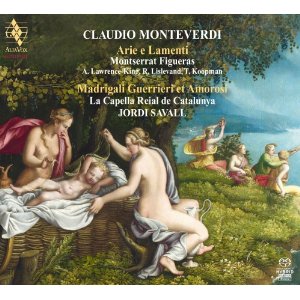
Arie & Lamenti
Madrigali Guerreri et Amorosi |
|
/aliavox_heritage.jpg) |
|
Réédition / Reissued
Alia Vox AVSA9884
(A + B)
Code-barres/Barcode:
7619986398846 |
|
Édition remasterisée |
Remastered edition |
|
Super Audio CD |
|
|
|
Description
|
CD 1
Arie e Lamenti per voce sola
Artistes / Performers :
Montserrat Figueras
A.Lawrence King
R.Lislevand
T. Koopman
Paolo Pandolfo
Lorenz Duftschmid
Lieu d'enregistrement
/ Recording site:Pieve de S. Martino, Emilia.
(05/1989)
Durée totale / Total
time: 61'30" |
CD 2
Madrigali Guerreri et Amorosi
Libro Ottavo
Artistes / Performers :
Montserrat Figueras
La Capella Reial de Catalunya,
dir. Jordi Savall
Lieu d'enregistrement
/ Recording site:Église Protestante, Ribeauvillé,
France (09/1994)
Durée totale / Total time: 56'46" |
|
Édition originale

Astrée E 8710 |
Édition originale
E 8546 |
|
Réédition Naïve
Naïve - 9955
|
Réédition Naïve
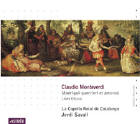
Naïve - 9944 |
|
|
|
 |
|
|
|
Évaluations recensées /
Reviews located |
|

03/1996
- re. CD II
|

# 379
(02/1992) -re. CD 1 (non localisé)
# 477
(01/2001) - re. CD 1 |
Classical Net (03/96)
Paul Riley |
|

19:5 (05/06 -
1996) - re. CD II
35:4 (03/04 - 2012) |

Par/By:Christiane
Bayer
|

Par: Monique
Parmentier
|
|

Claudio Monteverdi (1567-1643) |

Claudio Monteverdi (1567-1643) |
|

Extrait du livret / From the liner notes |
|
 Extraits
de l'essai rédigé par Silke Leopold pour la réédédition de ces
enregistrements: Extraits
de l'essai rédigé par Silke Leopold pour la réédédition de ces
enregistrements:
"Parmi les huit livres de madrigaux publiés en un demi siècle
par Monteverdi entre 1587 et 1638, le dernier occupe une place très
particulière. Imprimé en un temps où l’art vocal du madrigal –
généralement à cinq voix –, qui, en cent ans, s’était répandu non
seulement dans toute l’Italie mais également au nord des Alpes,
avait depuis longtemps dû céder sa position dominante à des formes
moins denses comme la cantate ou le duo, ce recueil apparaît comme
une sorte d’épode au temps passé; avec sa conception nouvelle du
phrasé entièrement basée sur des réflexions philosophiques, il
prépare le terrain à un langage musical axé sur l’émotion qui était
appelé à marquer toute une époque".
"Monteverdi a donné à son huitième livre
de madrigaux le titre de « Madrigaux guerriers et amoureux » et a
écrit, parallèlement à sa dédicace, un avant-propos dans lequel il
expose ses conceptions artistiques. La colère, la retenue et
l’humilité constitueraient ainsi selon Monteverdi les principales
émotions de l’âme humaine, à la rencontre desquelles le compositeur
doit avancer par une écriture à la fois violente, retenue et souple".
"Dans les Madrigali amorosi, la deuxième
partie du livre VIII des madrigaux, Monteverdi propose des sons plus
doux..."
"L’œuvre (cependant) par
laquelle Monteverdi a peut-être le plus influencé ses successeurs
sans pour autant qu’aucun d’entre eux ait jamais pu atteindre une
intensité émotionnelle comparable..."
Ce "... Lamento
della ninfa dans lequel une nymphe accompagnée d’un trio de voix
d’hommes pleure la perte de son amant infidèle, Monteverdi choisit
de calquer le tempo sur le propre rythme de l’âme en souffrance
plutôt que d’employer un tempo mesuré. Sur un ostinato du quatuor de
basses qui pour Bach, Schubert et Mozart constituera encore
l’expression même de la plainte, la nymphe chante sa douleur,
entourée de deux trios qui racontent son histoire" .
Poursuivez votre lecture - texte intégral
AVSA9884 : Cliquez
ici
~~~~~~~~~~
Excerpts
from the essay written by Silke Leopold for the re-issue of these
recordings:
"Among the eight
books of madrigals published by Monteverdi between 1587 and l638,
the last collection occupies a very special place. This collection,
printed when the art of the madrigal, generally in five voices,
which had indisputably reigned during at least one century over
Italy and also north of the Alps, had finally relinquished its
prominent position to lighter genres such as duets and cantatas,
seems to be a farewell to the past; with its innovative phrasing
grounded in philosophical views, it clears the way for a musical
language focusing on the emotions which was to put its stamp on
musical creation for a very long time".
"Monteverdi
entitled his eighth book of madrigals Madrigali Guerrieri et Amorosi
(War and Love Madrigals), and wrote beside his dedication a foreword
explaining his artistic views. In his view, anger, reserve and
humility are the main emotions of the human soul, which the composer
must express by a now violent, now restrained, now flowing writing".
"In the
Madrigali Amorosi (Love Madrigals), the second part of the book of
madrigals, Monteverdi uses softer sonorities".
"The work by
Monteverdi which had the greatest influence on his successors,
although none of them achieved a comparable emotional intensity,
belongs to the “Madrigali Amorosi...” (the)
... “Lamento
della Ninfa” in which a nymph accompanied by a trio of male voices
laments the loss of her unfaithful lover, Monteverdi models the
tempo on the inner rhythm of the suffering soul rather than using a
regular beat. Above a bass quartet ostinato, which for Bach,
Schubert and Mozart was to remain the true expression of complaint,
the nymph sings her sorrow, surrounded by two trios which tell her
story".
Read on - Full text
AVSA9884: Click
here
|
|
|
Gramophone-
(03/1996)
Re: CD II (Madrigali guerreri) |
|
Subscription
Abonnement |
Reviewer: Iain
Fenlon
The poetic title of
Monteverdi’s Eighth Book of Madrigals refers both to its internal
organization and also the whiff of an aesthetic programme in the
preface which speaks of the composer’s ‘invention’; in the concitato
genere. In practice this results in a limited number of techniques
(which Monteverdi arguably overuses) destined to broaden the
expressive potential of rhythm. Indeed, it is the madrigali guerrieri
that have attracted the most attention in the recording studio,
particularly the opening sonnet "Altri canti d'amor" and, above
all, "Hor ch'el ciel e la terra", currently available in some
half-dozen interpretations. Both occur in this selection together with
other well-known pieces including the "Lamento della ninfa" and the
ballo, "Volgendo il ciel", an attractively balanced grouping which
effectively presents a fair sample from this, the most heterogeneous
of all Monteverdi’s books.
The overall approach here is
robust and theatrical, making the most of all the possibilities for
virtuosic display that the music provides in its pursuit of heady
eroticism and high drama. In this the singers are ably supported by
some fine string playing, beautifully shaped and phrased, as well as a
luxuriant continuo grouping which includes theorbo, double harp,
harpsichord and organ. There is some splendid singing too; Lambert
Climent gives an eloquent account of the introduction to the ballo,
the men give a splendidly characterized reading of "Gira il nemico",
and Montserrat Figueras a persuasive account of the "Lament° della
ninfa".
There are also some less
satisfactory songs, however; the brilliant passagework which is such a
prominent feature of the book as a whole is sometimes ragged in
execution, there are occasional lapses of intonation among the
singers, and there is a certain amount of fussy added ornamentation in
the string parts that at times becomes intrusive and distracting. All
in all, a mixed blessing.
|
|
Diapason- # 477
(01/2001)
Re: CD I (Arie & Lamenti) |
|
Appréciation

Evaluation |
Abonnement
Subscription |
Analyste: Roger
Tellart
Texte intégral
C’est en femme émancipée que Montserrat Figueras aborde ici
Monteverdi, accompagnée par un subtil « concert » instrumental où se
remarque l’absence de la gambe de Jordi Savall, son mari. Une absence
qui prive peut-être ce récital d’une certaine dimension théâtrale,
pour privilégier, en revanche, le beau son avec le « bien- dire».
Toujours est-il
qu’on a connu au disque des Arianes plus égarées, mais certainement
pas plus crédibles (l’intelligence avec laquelle est exhalée la
dissonance initiale du Lamento fameux, écho de la « juste plainte »
dont le Crémonais était épris). Et la Lettre, toute d’intimité, est
fondamentalement amorosa, et sensuelle aussi, à défaut de brûler les
mots, comme dans la lecture exacerbée de la regrettée Cathy Berberian.
Une réédition qui comblera tous les amoureux de la vocalité vulnérable
de « Monsé » et qui en séduira bien d’autres. |
|
Classical Net (03/96)
Re: CD II |
|
Appréciation

Evaluation |
|
| |
|
Reviewer: Paul
Riley
A sumptuous
Monteverdian treat
Monteverdi had just turned 70 when the Eighth Book of Madrigals
appeared in 1638; 20 years had elapsed since Book 7 and Monteverdi’s
renewed flirtation with publishing perhaps stemmed in part from a wish
to show the younger generation snapping at his heels that there was
still plenty of life in the old dog. Moreover he was keen to
consolidate links with the Hapsburg Court at Vienna, dedicating the
volume to the new Emperor Ferdinand III: “to the son’s feet a present
initially meant for the father.” Rich in contrasting imagery the dual
theme of love and war sparked some of Monteverdi’s most inspired music
to date. Lamento della Ninfa in particular would haunt the operatic
stage through to Purcell’s Dido and beyond.
At the beginning of the
seventeenth century, Artusi took Monteverdi to task for what he
considered to be far-out harmonic innovations. When composing
Madrigali Guerrieri et Amorosi (Madrigals of War and Love), Monteverdi
was perhaps still smarting from the spat, and went to great lengths to
stress a classical foundation to the three musical styles cited in its
preface: anger, prudence and humility, he insisted, were the three
guiding emotions and each required a distinctive musical profile.
Jordi Savall and La
Capella Reial de Catalunya get to the heart of all three, living each
piece as the self-contained drama which it is, yet never losing sight
of the wood for the trees. Everything has been scrupulously prepared,
but in performance a vibrant spontaneity takes over.
The Stile Concitato
(warlike style) is irresistible, instrumental incisiveness going hand
in hand with vocal punch, and if the recording is a touch resonant
that resonance really lends excitement to the clangour. Not that
subtlety is in short supply either. Il Gira Il Nemico Insidioso Amore
opens with a wonderful sense of conspiracy which neatly modulates into
telling urgency, the Ballo dances joyfully along, buoyed up by some
extremely distinguished instrumental playing, and the sharp contrasts
of Hor che’l ciel e la terra are magnificently registered.
Throughout, the singing
continues to be both true to the impulse of the individual lines yet
powerfully cohesive and mutually responsive. There are a couple of
wobbles, and in solos one or two voices might not be to all tastes,
but as an ensemble they are dangerously seductive. Even those familiar
with these works should prepare to fall in love with Monteverdi all
over again.
|
|
19:5 (05/06 -
1996) - re. CD II |
 |
Abonnement
Subscription |
Reviewer: J.
F. Weber
Abridged version :
" ... the
strength of Jordi Savall's disc is the warm-sounding Mediterranean
vocal ensemble. Its stellar member is Montserrat Figueras, but her
voice by no means dominates the group, and one of the war songs, Gira
il nemico, is set for
three males voices only. Like a couple of Italian vocal groups that
have recently entered the lists, these voices could never be mistaken
for the Consort of Musické. I have praised the latter group's work at
great length, but there is a different set of strengths, and true
collectors will want to hear both approaches to Monteverdi".
"The sound captured in a
French church is lovely. The notes are useful, and texts come with
translations. Highly recommended".
This article is
available on the web to subscribers
of Fanfare. |
35:4 (03/04 - 2012) |
 |
Abonnement
Subscription |
Reviewer: J.
F. Weber
This is being written a day after the passing of Montserrat Figueras
at the age of 69 after a year’s illness*.
Her legacy of more than 30 years of recordings began with study at
Schola Cantorum Basiliensis with her husband, Jordi Savall, their
founding of the ensemble Hespèrion XX (now XXI) in 1974, and decades
of concerts and recordings on Teldec, Electrola Reflexe, Astrée, and
their own label, Alia Vox. Teldec issued one of her first records with
Savall and Ton Koopman among the players, a collection of Baroque
Spanish music. The first album under review here was originally two
singles on Astrée (Fanfare 15:6 and 19:5), now reissued in Super Audio
like many others.
The first disc in the set is a group of 10 solo works of Monteverdi
including the contrafact lament of the Madonna (based on Ariadne’s
lament). The ensemble that accompanies her includes Ton Koopman and
Andrew Lawrence-King. The notes by Harry Halbreich (from the original
issue) are informative and helpful, clarifying the stature of these
works. He calls Lettera amorosa “the crowning glory of the Seventh
Book of Madrigals”; Lamento d’Arianna was “Monteverdi’s most famous
and widely circulating piece” in his own day; its contrafact Pianto
della Madonna was placed as the climax of the 1640 collection of
sacred music. Four other works are set to sacred texts and three to
secular. All of these selections were readily available when the disc
was first issued, but few of them demonstrated the warmth and
intensity that Figueras brought to her interpretations, and of course
the collection of 10 pieces could not be matched by any other program.
The other disc in the first set groups six works from the composer’s
Book 8, drawing equally from both halves of the collection, including
the songs announcing both themes, war (“Others Sing of Love”) and love
(“Others Sing of War”). Given the number of complete sets of Book 8,
which fill three discs, the value of this single-disc sampling resides
in the inclusion of such masterly works as Gira il nemico, Volgendo il
ciel, Lamento della Ninfa, and Hor che’l ciel, together with the
exquisite ensemble performances. Two brief sinfonias are added. The
original notes by Silke Leopold point out the salient features of the
works selected for inclusion.
*
Montserrat Figueras died of cancer on November 23, 2011. |
|
Autres références disponibles via la base de données de
Todd McComb/ Other available references via Todd McComb's database:
(Site: http://www.medieval.org)
re: CD
I: Arie e lamenti per voce sola
re: CDII:
Madrigali guerrieri et amorosi |
|
|
|
|
To order / Commander
Réédition / Reissued
Alia Vox AVSA9884
(A + B)
Code-barres/Barcode :
7619986398846
|
Sélectionnez votre
pays et votre devise en accédant
à Presto Classical
(Bouton en haut à droite)
Livraison mondiale |

|
Choose your country
and curency when reaching
Presto Classical
(Upper right corner)
Worldwide delivery |
|


 |
|
|
La viole de gambe
Parutions récentes |
Viola da gamba
Recent releases |