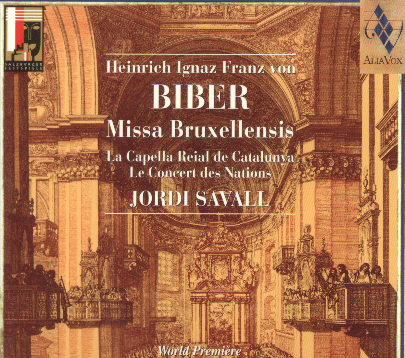
La cathédrale de Salzbourg fut construite pour
la première fois par l’évêque Virgile, alors que l’endroit était
encore une forteresse romaine et s’appelait Juvavum. Elle fut
incendiée en 1167, comme une grande partie de la ville, par les
partisans de l’empereur Frédéric Barberousse, et reconstruite dix
ans plus tard par l’archevêque Conrad III de Wittelsbach. Un autre
incendie en détruisit à nouveau plusieurs parties le 11 décembre
1598. Le 25 septembre 1628 la nouvelle cathédrale fut consacrée
avec un festival (peut-être le premier de Salzbourg) dont on garda
le souvenir pendant des décennies. D’après un chroniqueur anonyme,
« à tous les autels il y avait toute sorte de musiques, avec les
instruments, les orgues, chantant avec tant de joie et de grâce
qu’il était difficile de croire que, même au ciel, il pût exister
quelque chose de plus beau ou de plus heureux ».
"Biber", by Diego Fischerman, Goldberg # 23, Juin 2003
Salzburg cathedral was
first built on the site of a Roman fortress known as Juvavum
by Bishop Virgil. In 1167 followers of the Emperor Frederick
Barbarossa set it alight, together with the majority of the
city. It was reconstructed ten years later by the Archbishop
Conrad III of Wittelsbach. Another fire, on 11 December 1598
once again destroyed several sections of the building. On 25
December 1628 the new Cathedral
was consecrated with a festival—perhaps the first ever in
Salzburg—that would be remembered for decades. According to
an anonymous chronicler, “there were all kinds of music on
all the altars, with instruments, organs, making such a
joyful and attractive sound that it was difficult to believe
such beauty and holiness could exist, even in heaven
itself.”
"Biber", by Diego Fischerman, Goldberg
# 23, June 2003
"Peu de cours princières européennes
pouvaient offrir, au XVIIe siècle, une musique aussi somptueuse
que celle de l’Eglise Métropolitaine des archevêques de Salzbourg.
Au moins deux exemples remarquables en illustrent l’emploi dans
le cadre de célébrations liturgiques : d’une part, la fastueuse
consécration de la nouvelle cathédrale de Salzbourg en 1628, en
pleine guerre de Trente Ans, et de l’autre, en 1682, les
magnifiques fêtes célébrant l’anniversaire de la fondation de
l’archevêché par St. Rupert. Pour les deux occasions, la musique
était exceptionnelle. À la première fête, à en croire un
chroniqueur de provenance rurale, on offrait sur toutes les
tribunes, toutes sortes de musiques, sur des instruments, des
orgues, en chantant, et de façon si gracieuse et si gaie qu’on
faillît croire que même au ciel, ce ne pourrait être plus beau ni
plus gai”. L’autre fois, mettant en oeuvre presque tous les
instruments usuels à l’époque, on exécuta deux oeuvres à
cinquante-quatre voix, la Missa Salisburgensis et le motet
Plaudite tympana de Biber, qui, dès cette époque,
laissèrent sans doute une impression inégalable. Fascination
certes accentuée — jadis comme aujourd’hui encore — par
l’extraordinaire intérieur de la cathédrale de Salzbourg dont
l’architecture, plus qu’un merveilleux écrin, forme une unité
parfaite avec une musique de ce genre. Ce site unique a inspiré
des messes à gros effectifs vocal et instrumental à plusieurs
compositeurs baroques dont Heinrich Ignaz Franz Biber fut l’un des
plus importants et des plus connus."
"Biber choisit pour cette messe une distribution
correspondante à la pratique musicale usuelle dans la cathédrale
de Salzbourg lors des événements festifs où le prince archevêque
célébrait lui-même, à savoir un choeur double à huit voix avec
soli et tutti, un choeur de vents à cinq voix (deux
cornets à bouquin et trois trombones), un choeur de cordes à cinq
voix
(deux violons et trois altos), un choeur de trompettes et de
timbales à quatre voix, ainsi qu'un groupe de basse continue bien
fourni, comportant orgue, cordes et bassons. La disposition des
chanteurs (solistes et choristes) et des instrumentistes, répartis
sur les tribunes de la croisée et dans le choeur de la cathédrale,
offre une aventure sonore inédite dont ce lieu semble bien avoir
le monopole. Au mieux, un eneregistrement sur le vif pourrait en
transmettre une impression à-peu-près approchante."
Ernst Hintermaier
Traduction: Agnes Ploteny
"Few princely courts in l7th century
Europe could boast music as sumptuous as that of the Metropolitan
Church of the Archbishops of Salzburg. At least two remarkable
examples illustrate the use of such music in liturgical
celebrations: the lavish ceremony to consecrate the new cathedral
of Salzburg in 1628, at the height of the Thirty Years War, and
the magnificent celebration, in 1662, of the anniversary of the
foundation of the archbishopric by Saint Rupert. The music for
both occasions was exceptional. According to one rural chronicler,
at the celebrations marking the consecration of the cathedral
there were all kinds of music being performed at all the stands,
with instruments, organs and singing, and all with such elegance
and gaiety that one could scarcely imagine anything more beautiful
and joyous in Heaven itself”. On the second of the two occasions
mentioned, two works for fifty-four voices, employing almost all
the instruments commonly in use at that time, were performed: the
Missa Salisburgensis and Biber’s motet Plaudite tympana.
No doubt these works made an incomparable impression on all those
who heard them, enhanced then as they are todav by the
extraordinary interior of Salzburg Cathedral. Not only is the
architecture a wonderful backdrop to music of this kind; it forms
a perfect whole with it. The unique setting of the cathedral
inspired several Baroque composers to write masses for a large
number of instruments and voices, one of the foremost and best
known of those composers being Heinrich Ignaz Franz Biber."
"For this mass, Biber
chose a distribution which corresponded to usual musical practice
at the cathedral in Salzburg during festive events at which the
prince-archbishop was the celebrant: a double eight-voice choir
with soli and tutti, a five-part wind chorus (two
horns and three trombones), a five-part string chorus (two violins
and three viols), a four-part chorus of trumpets and drums, as
well as a substantial continuous bass consisting of organs,
strings and bassoons. The disposition of the singers (soloists and
choristers) and the instruments, in the stalls around the transept
and in the cathedral choir, marked an unprecedented musical
adventure in which the setting itself played a central role. Only
a live recording could perhaps convey an approximate impression of
what it must have been like."
Reviewer: Jonathan
Freeman-Atwood Excerpt: "Savall
lets Biber's score roll out unassumingly; even if at the expense of
fine tuning and exacting ensemble (hear the unison start of the
Sanctus for leeway!), the final sections of the
Credo are immensely stylish, and the 'Miserere' from the
Gloria has the dignity of a spontaneous event rather than a
contrived vignette."
Découverte à la Bibliothèque royale Albert 1er
de Bruxelles (d’où son nom) et attribuée sans risque d’erreur à
Biber la Missa bruxellensis fur probablement composée pour
une cérémonie solennelle à Salzbourg au début du XVIIe siècle,
peut-être à l’occasion de la fondation de l’ordre des chevaliers de
saint Rupert, ce qui se situerait précisément en novembre 1701.
L’œuvre est moins fastueuse que la fameuse Missa salisburgensis
à cinquante-quatre voix, puisqu’elle n’en propose que ( !)
vingt-trois réparties en cinq chœurs. Elle est plus tardive
aussi, ce qui se traduit par une écriture harmonique plus fine et
plus élaborée et par un discours moins fragmenté jouant sans cesse
cependant de contrastes appuyés. Après l’avoir interprétée en
concert dans la cathédrale de Salzbourg, Jordi Savall en propose une
première gravure mondiale où a été respectée la disposition spatiale
originale avec ses quatre tribunes et son choeur. Le résultat est
grandiose, qui transmet l’acoustique profonde de la cathédrale avec
un relief exceptionnel : les cinq formations (deux choeurs à huit
voix avec chacun quatre solistes, un choeur de trompettes et
timbales, un autre de saqueboutes et cornets, le dernier avec les
cordes et le continuo – auxquels s’ajoutent les quatre orgues des
tribunes) sont parfaitement identifiables et suscitent de splendides
effets « stéréophoniques ». Les trompettes sont très sollicitées –
notamment dans le « Gloria » - mais la Missa Bruxellensis
semble moins pompeuse que la salisburgensis. L’alternance de
morceaux brillants et rapides et d’adagios progressant en valeurs
longues, les nombreux passages concertants et mélismatiques dévolus
aux solistes (le début du « Credo », par exemple, avec les
entrées successives du contre-ténor puis des autres solistes selon
une grammaire très « versaillaise »), le chromatisme exacerbé du « Crucifixus »
ou encore le brillant dialogue du « Resurrexit » créent une
tension et un intérêt permanents, faisant de cette Messe un
joyau de l’art baroque décoratif autrichien. Savall équilibre
parfaitement tous ces paramètres parfois contradictoires, dans une
ambiance d’exaltation et de ferveur qui transcende une partition
n’évitant pas toujours les stéréotypes mais rendue avec une grandeur
et une beauté qui nous renvoient sans écran aux fastes salzbourgeois
de la fin du XVIIe siècle.
Chose promise,
chose due : Savall nous émerveille à nouveau. Autant son dernier
disque ne nous avait pas convaincu (voir
Classica no. 17),
autant ici nous retrouvons la verve et l’éclat des grandes
réalisations du Catalan. La dimension généreuse de la cathédrale de
Salzbourg, théâtre vivant des compositions religieuses de Biber,
avait déjà vu la résurrection de la Missa Salisburgensis par
McCreesh il y a peu (Archiv, voir Classica no. 5) ; voici qu’elle
transcende sans peine la reconstitution d’une Messe bruxelloise
(nom donné par la localisation de la partition) qui est l’une des
dernières du compositeur. Si l’on regrette parfois la trop grande
réverbération d’une acoustique surdimensionnée au disque, on restera
subjugué par l’effet de l’ensemble (mais attention cependant à la
justesse des trompettes !). Longtemps compositeur de musique
instrumentale, Biber s’est attaché à partir de 1684 à produire des
partitions d’envergure titanesque avec tout le succès possible : « Sur
toutes les tribunes, toutes sortes de musiques, sur des instruments,
des orgues, en chantant, et de façon si gracieuse et si gaie qu’on
faillît croire que même au ciel, ce ne pourrait être plus beau ni
plus gai. » Le défi est amplement relevé ici avec deux chœurs
généreux, desquels la voix de Pascal Bertin émerge sans peine. Merci
Monsieur Savall!
Goldberg # 10
Printemps/Spring 2000
Appréciation
Evaluation
Goldberg a cessé de publier
avec le # 54
~~~~~~
Goldberg is no longer available.
# 54 was the last issue.
Analyste: Lionel
Salter
Texte intégral:
La splendeur de la cathédrale de Salzbourg
inspira aux compositeurs, pour les interpréter, des oeuvres
religieuses somptueuses, employant un grand nombre d'instruments et
de voix. Suivant les techniques utilisées un siècle plus tôt à
Venise par Gabrieli, Biber écrivit plusieurs messes de grande
envergure ( y compris la Missa Salisburgensis, dont
l'attribution a souvent été erronée), mettant à profit les
possibilités d'une spectaculaire présentation spatiale de ses
effectifs. La Missa Bruxellensis (qui tire son nom simplement
de l'endroit où le manuscrit fut trouvé) fut composée en 1701 pour
célébrer la fondation de l'ordre des Chevaliers de Saint-Rupert (un
ordre militaire), requiert un double choeur de huit voix (avec
solistes) et trois ensembles instrumentaux, de cornets et trombones
à coulisse, de cordes, et de trompes et tambours respectivement.
Jordi Savall a déployé cet ensemble dans la cathédrale même de
Salzbourg. Son vaste espace à la grande résonance amena Biber à
favoriser la texture homophonique plutôt que la polyphonique (mais
le contrepoint n'est absolument pas absent, comme dans la fugue "Qui
tollis peccata") avec des contrastes bien conçus de soli et de tutti
(en particulier dans le Credo) pour éviter une sonorité
excessivement riche. Les trompettes sont remarquables dans le
Gloria, le "Et accendit" et le "Et expecto", mais "Miserere nobis",
"Incarnatus" et "Benedictus" sont profondément expressifs. Savall
conduit habilement l'oeuvre dans l'espace de la cathédrale, et tous
les exécutants le servent à merveille, ce qui fait un succès de
l'interprétation de cette oeuvre splendide. L'équipe
d'enregistrement doit également être félicitée, aussi bien pour
avoir capté la magnificence de l'exécution que pour avoir garanti
l'équilibre et la remarquable clarté des parties vocales.
The splendour of Salzburg Cathedral
inspired composers to write sumptuous religious works, employing
large numbers of instruments and voices, for performance there.
Following Gabrieli's procedures in Venice a century earlier,
Biber wrote large-scale Masses (including the often misattributed
Missa Salisburgensis) exploiting the possibilities for dramatic
spatial presentations of his forces. The Missa Bruxellensis (which
owes its appellation merely to the place where the manuscript was
found) was written in 1701 to celebrate the founding of the Order of
the Knights of St. Rupert (a military order), and calls for a double
eight-voice choir (with soloists) and three instrumental groups,
respectively of cornetts and sackbuts, strings, and trumpets and
drums. Jordi Savall has deployed these forces in Salzburg Cathedral
itself. Its vast reverberant space led Biber to favour homophonic
rather than polyphonic texture (though counterpoint is by no means
lacking, as in the "Qui tollis peccata" fugue), with well-planned
contrasts of soli and tutti (notably in the Credo) to avoid too
consistently rich a sonority. Striking are the trumpets in the
Gloria, at "Et ascendit" and "Et expecto", but deeply expressive are
"Miserere nobis", "Et incarnatus" and "Benedictus". Savall paces the
work skilfully in this venue, and he is excellently served by all,
for whom the performance of this splendid work is a triumph. The
recording team too is to be congratulated on both capturing its
magnificence and securing balance and remarkable clarity of the
vocal lines.
This
Missa Bruxellensis " ...
disposes two four-voice choirs and two brass choirs in the four
galleries that project from the pillars of the cathedral. Unlike
(the Missa Salisburgis),
however, the string ensemble placed on the floor is relatively
modest, making a total of 23 voices. While there is still a high
level of pomp here, the trumpets being prominent in a martial
manner, this seems to me to come closer to the purpose of liturgical
music than the Salzburg Mass does.
Biber manages to enhance the most tender liturgical text-setting
with brass reinforcement that lends strength without swamping the
singers. For Et incarnatus est and Crucifixus the voices interweave
delicately with little or no accompaniment. The trumpets then enter
at Et resurrexit to great effect. Even though the performing forces
are more limited than the more varied groups that populate the
galleries in the Salzburg Mass, the people are spread around the
dome to the same effect as the larger work achieves. Missing are the
two distant groups of trumpets and drums that punctuate the other
Mass so forcefully. Missing here, perhaps, but not really missed".
"Savall
shows a real flair for this kind of music. ...give
this a hearing. It's a winner".
HEINRICH FRANZ VON BIBER par Diego Fischerman Goldberg # 23 - juin 2003 Ce texte n'est
plus disponible sur le web.
HEINRICH FRANZ VON BIBER by Diego Fischerman Goldberg # 23 - June 2003
No
longer available on the web.
Heinrich Biber Homepage by James Clements (includes a thorough
discography - last updated: 2011/06)
La musique / The music
Missa Bruxellensis XXIII vocum
1. Kyrie
2. Gloria
3. Credo
4. Sanctus
5. Agnus Dei
Autres références disponibles via la base de
données de Todd McComb/ Other available references via
Todd McComb's database:
(Site: http://www.medieval.org)
Re:
AV9808





 La cathédrale de Salzbourg fut construite pour
la première fois par l’évêque Virgile, alors que l’endroit était
encore une forteresse romaine et s’appelait Juvavum. Elle fut
incendiée en 1167, comme une grande partie de la ville, par les
partisans de l’empereur Frédéric Barberousse, et reconstruite dix
ans plus tard par l’archevêque Conrad III de Wittelsbach. Un autre
incendie en détruisit à nouveau plusieurs parties le 11 décembre
1598. Le 25 septembre 1628 la nouvelle cathédrale fut consacrée
avec un festival (peut-être le premier de Salzbourg) dont on garda
le souvenir pendant des décennies. D’après un chroniqueur anonyme,
« à tous les autels il y avait toute sorte de musiques, avec les
instruments, les orgues, chantant avec tant de joie et de grâce
qu’il était difficile de croire que, même au ciel, il pût exister
quelque chose de plus beau ou de plus heureux ».
La cathédrale de Salzbourg fut construite pour
la première fois par l’évêque Virgile, alors que l’endroit était
encore une forteresse romaine et s’appelait Juvavum. Elle fut
incendiée en 1167, comme une grande partie de la ville, par les
partisans de l’empereur Frédéric Barberousse, et reconstruite dix
ans plus tard par l’archevêque Conrad III de Wittelsbach. Un autre
incendie en détruisit à nouveau plusieurs parties le 11 décembre
1598. Le 25 septembre 1628 la nouvelle cathédrale fut consacrée
avec un festival (peut-être le premier de Salzbourg) dont on garda
le souvenir pendant des décennies. D’après un chroniqueur anonyme,
« à tous les autels il y avait toute sorte de musiques, avec les
instruments, les orgues, chantant avec tant de joie et de grâce
qu’il était difficile de croire que, même au ciel, il pût exister
quelque chose de plus beau ou de plus heureux ».