|
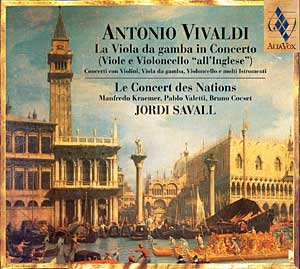
Antonio Vivaldi (1678-1741) |
|
| |
La Viola da gamba in
concerto
(Viole & Violoncello "all'Inglese") |
|
| |
|
Description
Artistes / Performers
Le Concert des Nations,
Manfredo Kraemer, Pablo Valetti, Bruno Cocset, Imke David,
Jordi Savall, dir.
Lieu d'enregistrement / Recording site:Collégiale
du Château de Cardona (Catalogne / Catalunya)
Date d'enregistrement: Sept.
2003
Recording date: Sept.
2003 Durée totale / Total time: 61'13

|
|
| |
 |
|
La Viola da gamba in
concerto
(Viole e Violoncello “all’inglese”) |
|
Cet enregistrement réunit tous
les “Concerti” de Vivaldi contenant des parties obligées
pour les Violes de gambe qui sont indiquées dans les
manuscrits originaux sous les termes Violoncello et
Viole (ou Violette) “all’Inglese”. Ces magnifiques œuvres
sont complétées par le Concert en fa majeur pour
violon et violoncelle, le Concert en si mineur avec
4 violons et violoncelle et les Concerti en ré mineur
et sol mineur où la partie de violoncelle est jouée
par la viole de gambe.
Jordi Savall |
|
It is only recently that two
seemingly unconnected names, those of Vivaldi and the viola
da gamba, have been uttered in the same breath. The
established, uncontested view on the matter was quite simply
this: from the middle of the 17th century, the viol, which
was still flourishing north of the Alps, had all but
disappeared in Italy, where it had been replaced by the bass
violin and, subsequently, by the cello.
Yet, among the more than 800
surviving works by Antonio Vivaldi (1678-1741), five include
movements for an instrument that Vivaldi refers to variously
as "viola inglese" (English viol), "viola all inglese" or "violoncello
all‚inglese".
The album La Viola da gamba in Concerto brings together all
of Vivaldi's concerti containing one or several parts
written expressly for the viola da gamba. Of these, three
contain handwritten notes by the composer calling for the
"viole all’inglese".
|
|
Appréciation (s) /
Review(s) |
|
|

#
511 (02/2004) |

# 60 (03/2004) |
|

28:2 (Nov/Dec 2004) |

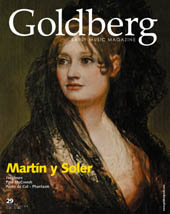
# 29
(08/2004) |
Monde de la Musique
# 284 (Février 2004)
|
|

Antonio Vivaldi (1678-1741) |

Antonio Vivaldi (1678-1741) |
|
Extrait du livret / From the liner notes |
|
Concertos pour viole
de gambe
Vivaldi et la viole :
voici deux concepts qui, jusqu’à tout récemment avaient
été rarement mis en connexion. Comment ignorer, du fait
des témoignages d’André Maugars en 1639 et de Thomas Hill
en 1657 que la viole, toujours florissante au nord des
Alpes, avait pratiquement disparu en Italie, car remplacée
par la basse de violon qui, construite d’abord dans une
taille légèrement plus petite et avec des cordes couvertes
et un accord différent, devait devenir, quelques décades
plus tard, le violoncelle ? Et Vivaldi n’était-il pas un
compositeur à la pointe du progrès qui aurait dû tourner
le dos à une telle relique du passé ?
Et cependant : parmi les centaines de compositions de
Vivaldi
...
Poursuivez votre lecture...
cliquez ici
|
La
Viola da gamba in Concerto
Vivaldi and the viol are two concepts that until very
recently have rarely been brought into conjunction. Did we
not know from the testimonies of André Maugars in 1639 and
Thomas Hill in 1657 that the viol, still thriving north of
the Alps, had already become an all-but-extinct instrument
in Italy – replaced by the bass violin, which, when built in
a slightly smaller size, with covered strings and altered
tuning, would in a few decades become the cello? And was not
Vivaldi an ultra-progressive composer who would have turned
up his nose at such a relic of the past?
And yet: among Vivaldi’s hundreds of surviving compositions
(over 800 at the latest count) are five that include parts
for an instrument called by the composer “viola inglese”,
“viola all’inglese” or (in one case) “violoncello
all’inglese”. This “English viol” or “English-style viol” is
clearly not a member of the violin family played in a
special manner – five-note and six-note chords in one of the
works concerned put paid to that idea – but if not, then
what?
Read on...
click here
Then search
VIVALDI
in the search tool. |
|
|
28:2 (Nov/Dec 2004)
|
 |
Abonnement
Subscription |
|
Reviewer: Robert Maxham
Excerpts:
"The violas appear in diverse
combinations with the other solo instruments, varying from homophony,
although with strongly contrasting tonal characteristics in RV 546
to full fugal partnership in RV 565. Le Concert des Nations,
directed by Jordi Savall (who plays the bass viola da gamba in RV
546, RV 565, and RV 578 and the soprano I viola da gamba in RV 579
and RV 555), appears to be a small ensemble, with Manfredo Kraemer
serving as its concertmaster and solo violinist; but it unleashes a
maelstrom in the reverberant ambiance in the Collégiale du Château
de Cardona, where Alia Vox recorded the concertos in September 2003;
and the rich but clear recorded sound preserves the wide range of
tone colors".
"Collectors of Vivaldiana will hardly pause to consider the
merits of these performances: Talbot’s lucid notes, the attractive
packaging, and the warm recorded sound will confirm the headnote’s
automatic recommendation. Others may not wish to hear concertos not
written for gambas played by them. Recommended, therefore, primarily
to specialists". |
|
Diapason- # 511
(02/2004)
|
|
Appréciation
4 Diapason
Evaluation |
Abonnement
Subscription |
|
Analyste: Roger-Claude
Travers
Résumé ou abrégé:
Dans cet article R.-C. Travers souligne le fait que seulement trois
des œuvres au programme ont été en fait écrites pour la « viola
all’inglese » ou viole de gambe, soit les concertos RV 546, 555 et
579. Il semble par ailleurs faire reproche à Savall d’avoir inséré
au programme trois concertos extraits de l’Estro Armonico et de les
avoir interprétés à la viole et non au violoncelle. Travers salue
par ailleurs l’insertion au programme du RV544 « Il Proteo o sia il
mondo al rovescio », soulignant cette fois la contribution au
violoncelle de Bruno Cocset. Au sujet du 8ème concerto,
le RV579, il écrit : « Savourons le Funebre, ses chuintements
de violes, réunies en famille et les guirlandes d’orgue
consolatrices dans son Allegro poco poco, sourions en
complices du tricotage de l’archet, plus frénétique que précis,
quasi sur le manche… ».
Et il conclut en ces termes plutôt encourageants : « Des amours
vivaldiennes débutantes riches de promesses ». |
|
Reviewer:
Roger-Claude Travers
Abstract :
The reviewer underlines the fact that only three of
the recorded works were in fact composed for the « viola all’inglese »which
is now generally considered to be the viola da gamba. They are
concertos RV 546, 555 and 579. He questions with Savall’s decision
to include on this recording three concertos excerpted from l’Estro
Armonico and performed by Savall on the the viola da gamba instead
of the cello. On the other hand he praises the insertion in the
program of concerto RV 544 “Il Proteo o sia il mondo al rovescio”,
underlining the contribution of Bruno Cocset playing the cello. The
eight concerto in the program, RV 579, is also quite welcome.
Travers writes: “This Funebre” is delightful; with its
hushing sounds from the violas gathered as a family…” Travers
concludes on a rather encouraging tone: “These are early Vivaldian
encounters which are full of promises”. |
|
Classica- Répertoire
# 60 (03/2004)
|
 |
Appréciation:
Recommandé
8
Evaluation:
Recommended
|
Abonnement
Subscription |
|
Analyste: Serge Gregory
Résumé ou abrégé:
Trois concertos composés pour la Pieta (RV 546, 555 et 579) et
mettant en vedette la « viola all’inglese » ne font pas un
CD. Savall ajoute donc trois concertos pour violoncelle qu’il
« s’approprie sans complexe » comme nous le dit Serge Gregory et
qu’il interpr`te à viole. Ce dernier constate que « Le Concert
des Nations fait entendre un Vivaldi tonique, serein, enjoué,
virtuose, parfois au-delà de ses limites ». Pour ce critique, ce ne
sont que « broutilles » ces quelques remarques concernant le jeu de
Manfredo Kraemer « … quelquefois surpris en difficulté. Des moments
certes rares, car sa maestria fait merveille ailleurs… » Il trouve
également à redire quant à « … l’usage des trompettes baroques
montées en trompe marine... qui ne (lui) semble pas convaincant. »
Il conclut toutefois qu’il « … s’agit d’un disque
fort agréable, même s’il ne constitue pas un opus majeur, tant pour
Savall que pour Vivaldi. »
~~~~~~~~~~~~~~~~
En complément à l’analyse qui précède, voici une
appréciation (signée P.M.) de la qualité sonore du disque, telle que
parue dans le # 61 (Avril 2004) de
Classica/Répertoire :
Ce disque « … nous a semblé relever un beau défi : intégrer le
timbre à la fois discret et riche de la viole de gambe, avec toutes
ses subtiles nuances de prononciation., à un ensemble fort généreux
en timbres, avec ses violons, violoncelles, contrebasses, théorbe,
guitare, clavecins, sans parler des interventions des vents dans le
« Con molti stromenti ».
« Un régal pour gourmands de saveurs sonores ». | |